Guide // Chaos theory
What is a strange attractor?
A strange attractor is the shape a chaotic system settles into. The motion never repeats and can't be predicted for long, yet it always stays on the same delicate shape. Here is what that means, with the equations behind our posters.
01A point that follows a rule
Picture a single point moving through space. At every moment its velocity is set by a rule that depends only on where it is right now. Mathematicians call this a dynamical system, and the space it moves in the phase space.
Start the point anywhere and, after a while, it stops wandering and falls onto a particular shape. That shape is the attractor: the place the motion is drawn to and never leaves.
dx/dt = f(x)02Three kinds of attractor
The simplest attractor is a fixed point: a pendulum with friction ends up hanging still. The next is a loop, called a limit cycle: a heartbeat or a ticking clock repeats the same path forever.
The third kind is strange. The path never settles to a point and never closes into a loop, yet it stays inside a bounded shape. The name "strange attractor" was given by the mathematicians David Ruelle and Floris Takens in 1971.
03The Lorenz attractor and the butterfly effect
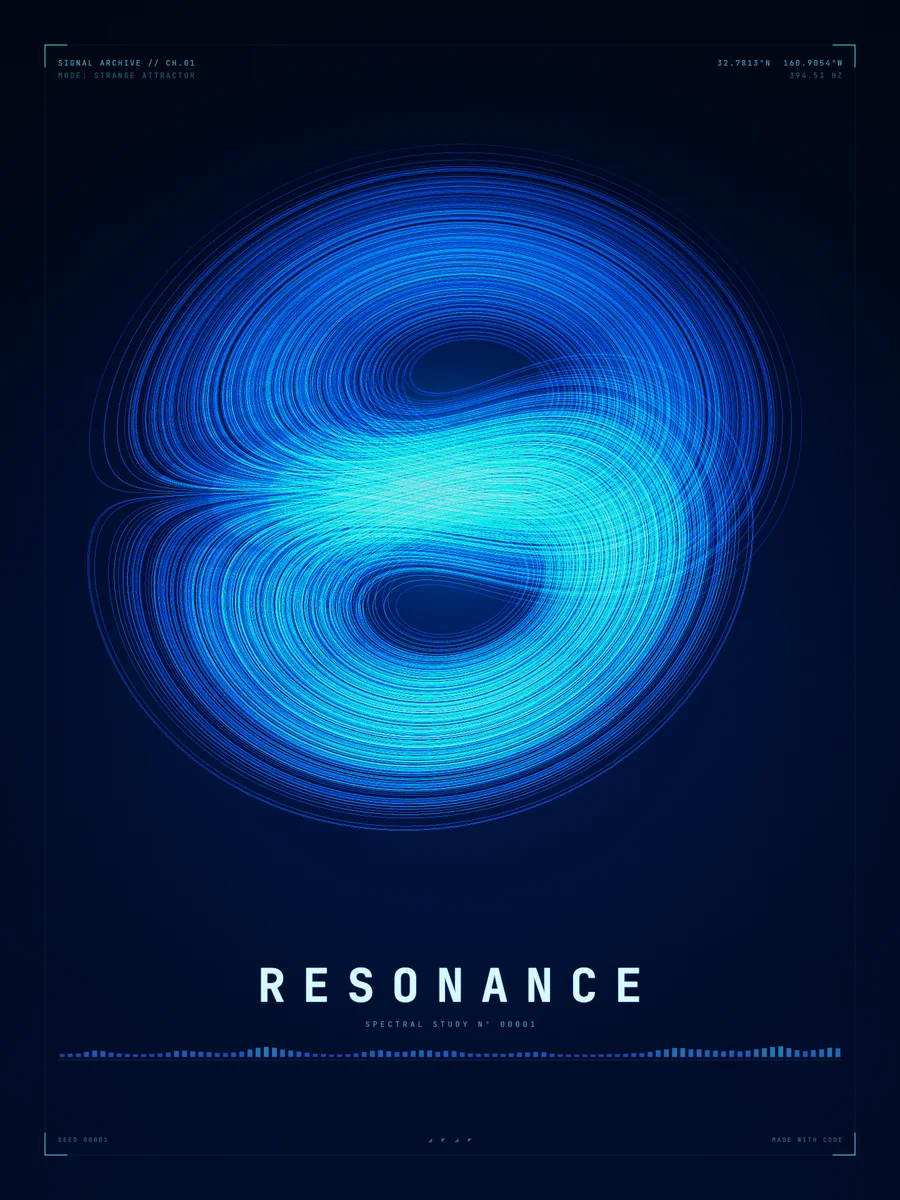
In 1963 the meteorologist Edward Lorenz reduced a model of warm air rising and falling to three equations. With σ = 10, ρ = 28 and β = 8/3, the solution traces the famous two-winged shape: the point loops around one wing, then jumps to the other, with no pattern in how many loops it makes before switching.
Lorenz noticed that two runs starting from almost the same numbers soon looked nothing alike. In 1972 he asked in a talk whether the flap of a butterfly's wings in Brazil could set off a tornado in Texas, and the idea got its name: the butterfly effect.
dx/dt = σ(y − x)dy/dt = x(ρ − z) − ydz/dt = xy − βz
04Why it is called chaos
Chaos here has a precise meaning: the system is fully determined by its equations, yet a tiny difference at the start grows exponentially. The rate of that growth is the Lyapunov exponent λ. When λ is positive, small errors double again and again, so long-range prediction is impossible.
For the Lorenz system λ is about 0.9. Our program measures it while drawing each poster: for the Lorenz piece it came out at 0.907, which means a difference between two nearby paths doubles roughly every 0.76 time units.
|δ(t)| ≈ |δ₀|·e^(λt), λ > 005A shape with a fractal dimension
Paths in phase space can never cross, because from any point the rule allows only one future. So the path keeps folding into ever thinner layers without touching itself. The result is a fractal: the Lorenz attractor has a dimension of about 2.06, a little more than a surface and far less than a solid.
06The Thomas attractor
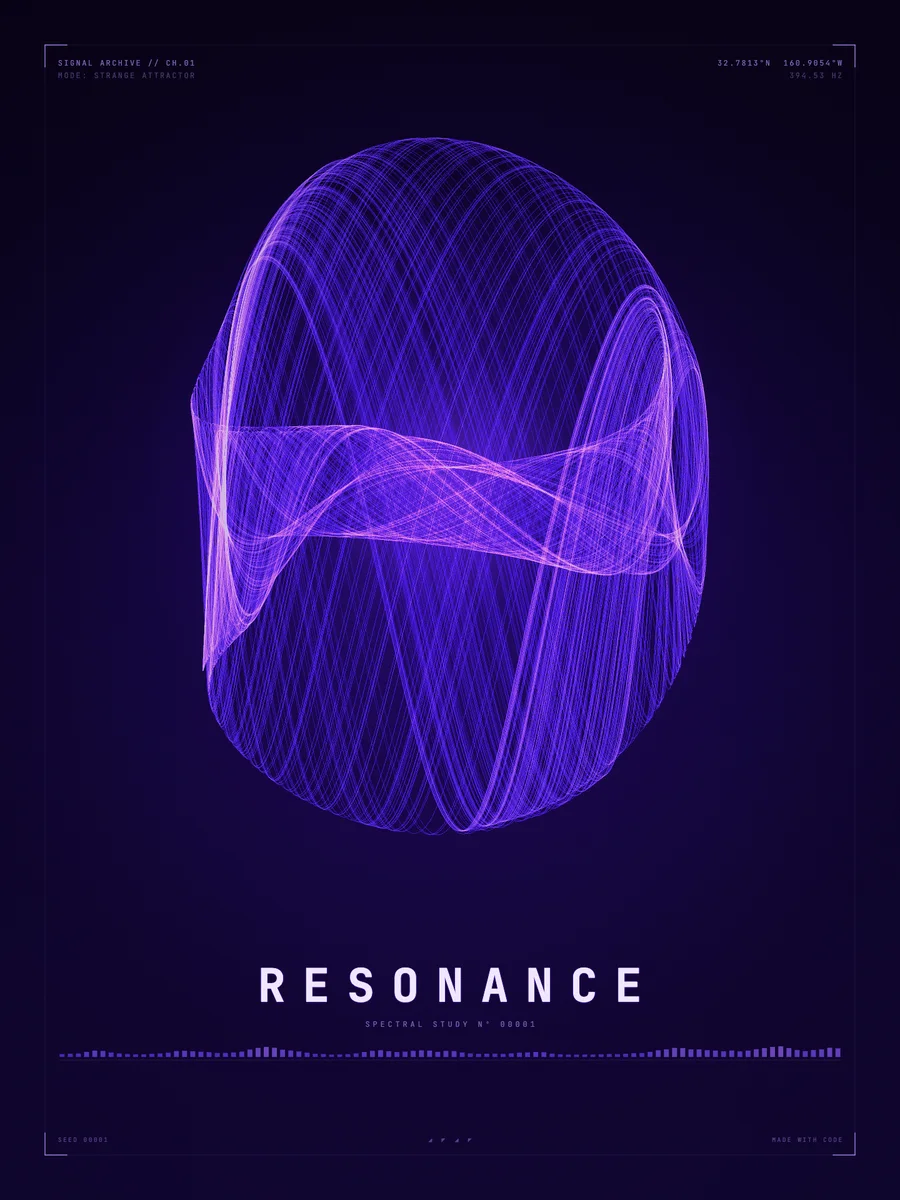
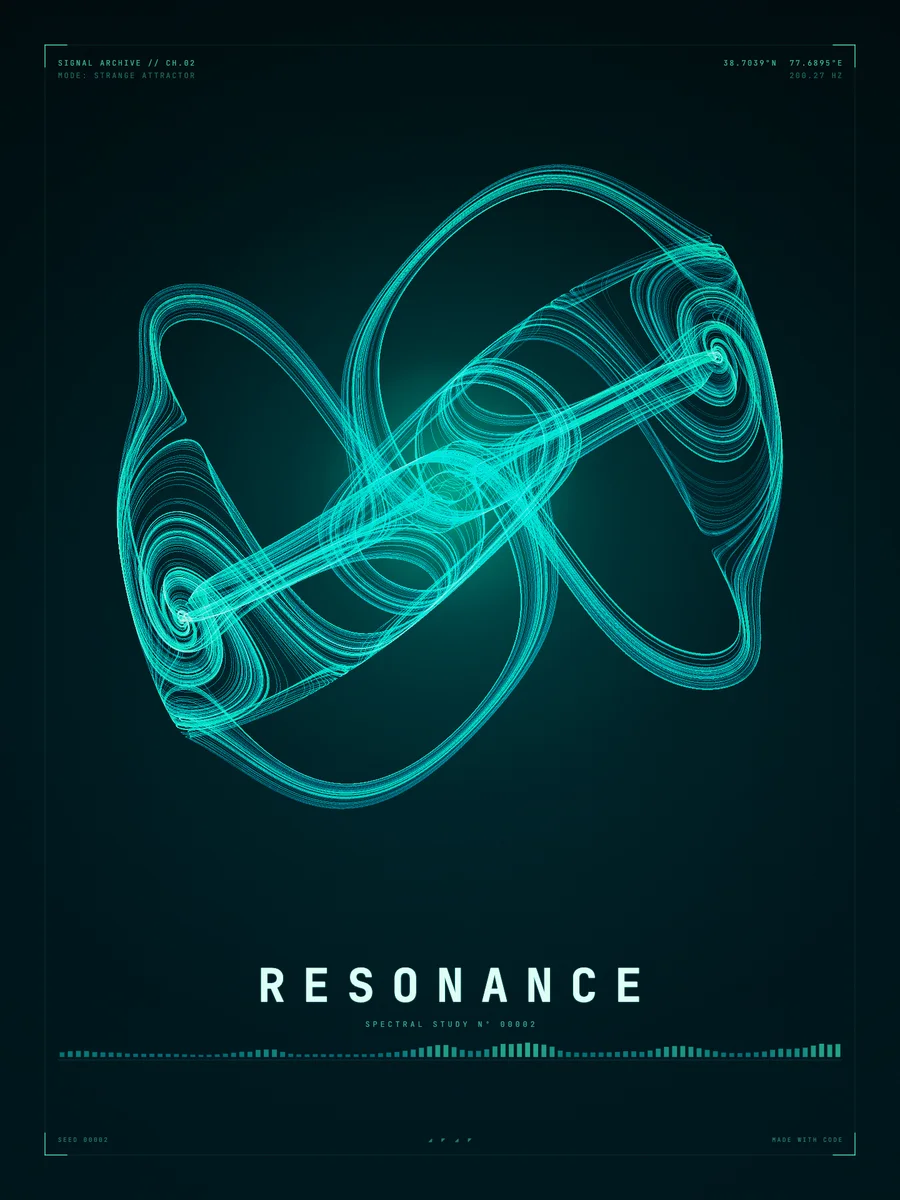
In 1999 the biologist René Thomas wrote down a system where each coordinate is pushed by the sine of the next one and slowed by friction b. The equations are cyclically symmetric: swap x, y and z in a circle and nothing changes.
For large b the motion dies down. Below about b = 0.208 it turns chaotic, and the point drifts through a labyrinth of sine waves. Our Thomas poster uses b = 0.18 and 420,000 steps.
dx/dt = sin y − bxdy/dt = sin z − bydz/dt = sin x − bz
07Attractors from two lines of code
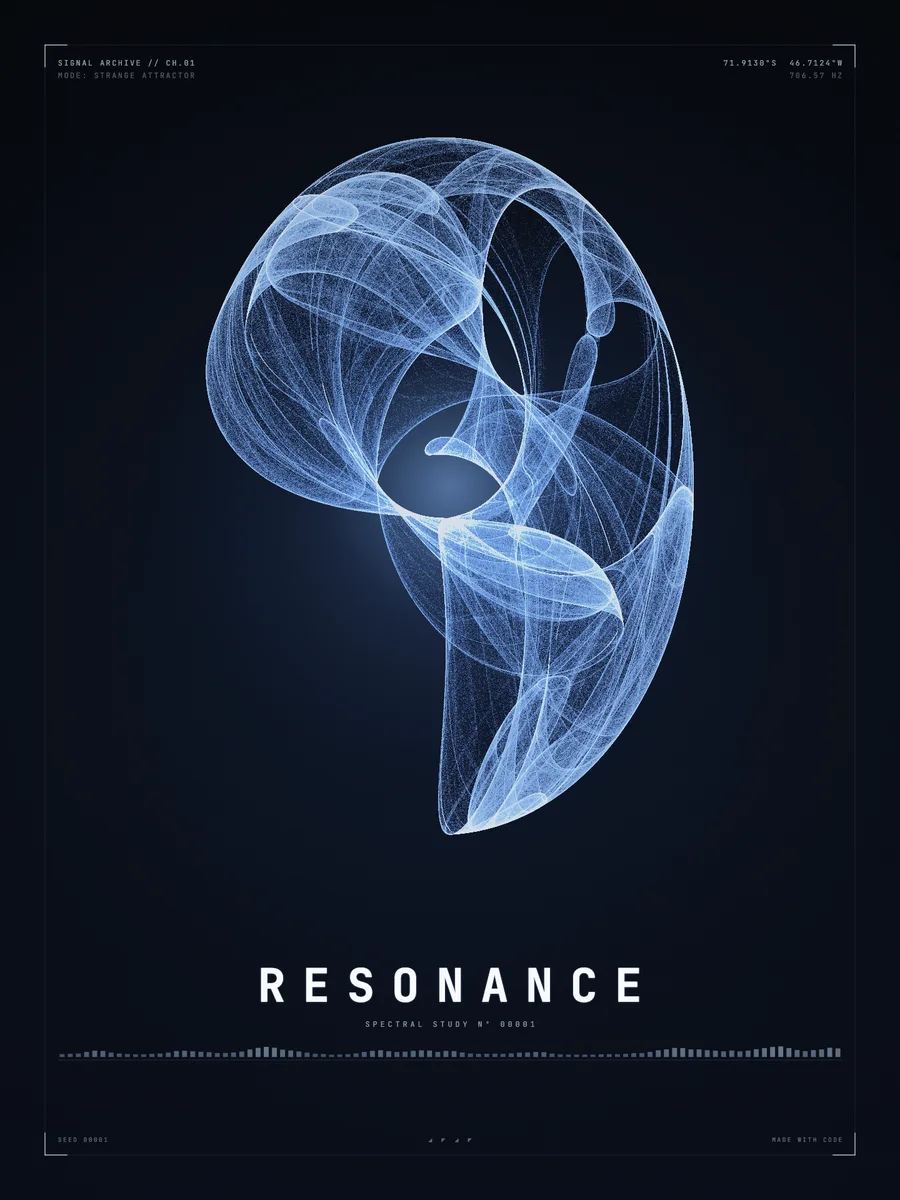
Not every attractor needs calculus. The Clifford attractor (named after Clifford Pickover) and the Peter de Jong attractor are maps: each new point is computed directly from the previous one with a few sines and cosines. Iterate a few million times and the points pile up into silk-like veils.
Change the four constants a, b, c and d slightly and the veil takes a completely different shape, which is why these maps are a favourite of artists who work in code.
xₙ₊₁ = sin(a·yₙ) + c·cos(a·xₙ)yₙ₊₁ = sin(b·xₙ) + d·cos(b·yₙ)
08How our attractor posters are drawn
For the three-dimensional systems the program solves the equations with the fourth-order Runge-Kutta method, a standard way to follow a path accurately in small time steps. It records every step, hundreds of thousands of them, and projects the 3D path onto the page from a chosen angle.
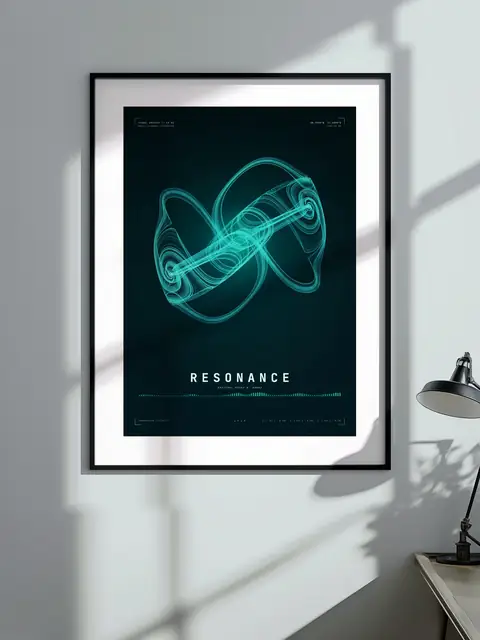
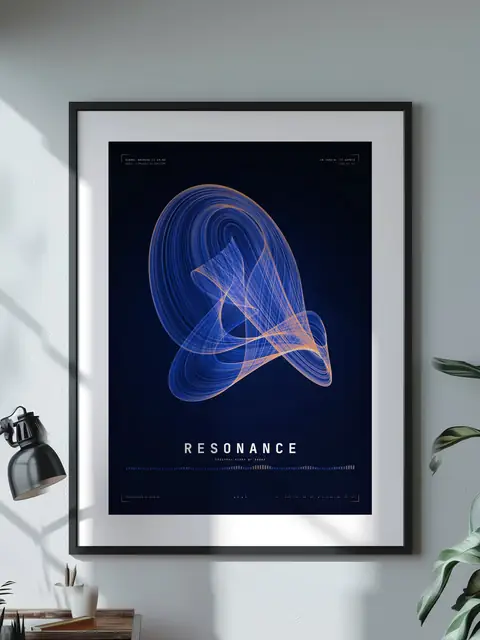
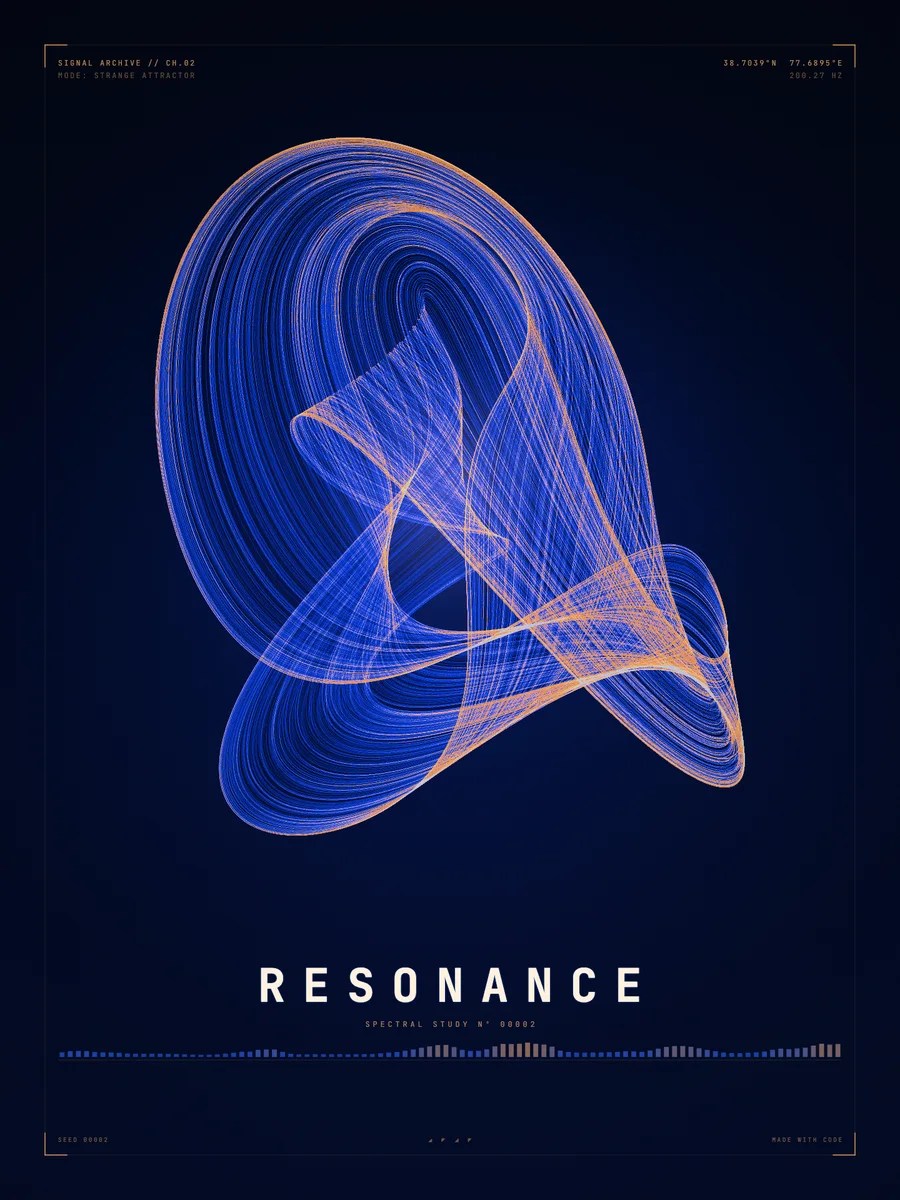
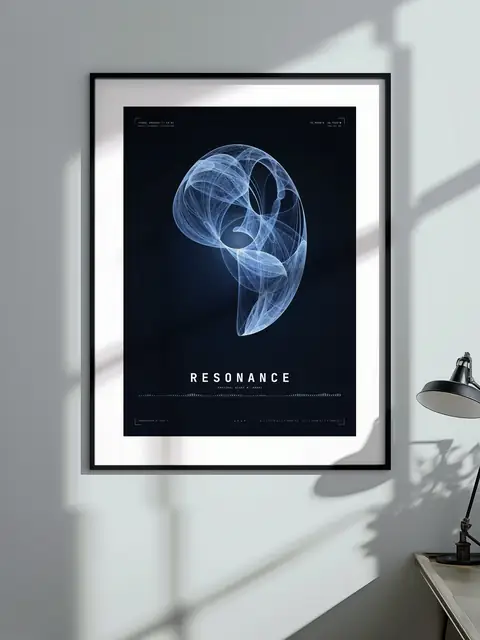
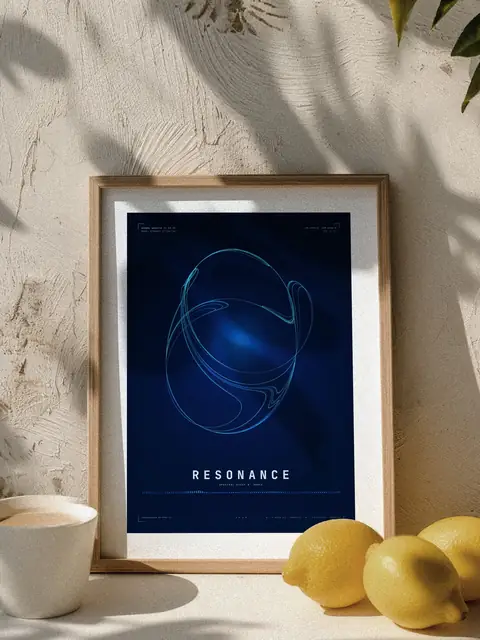
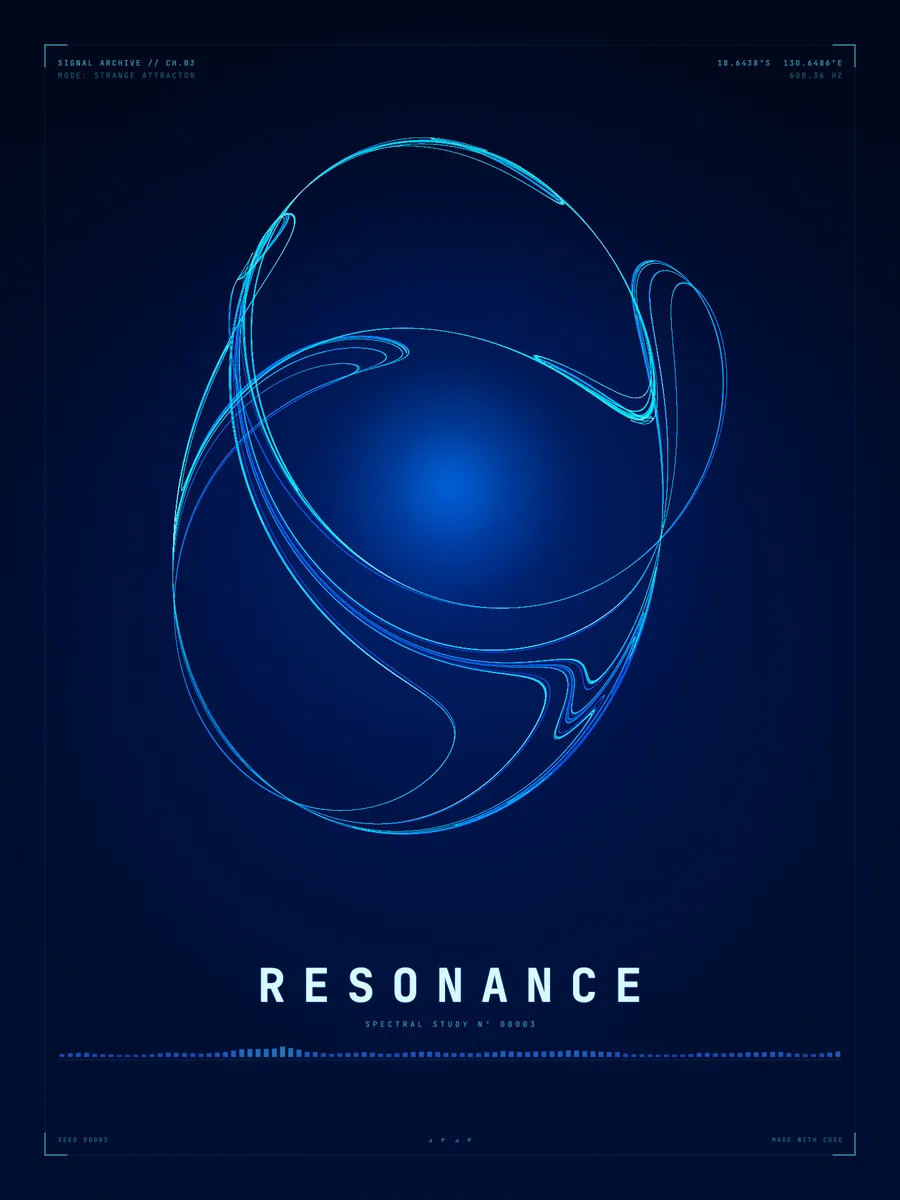
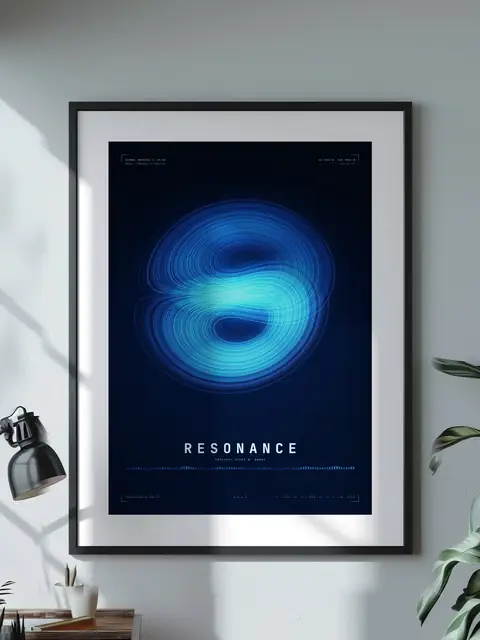
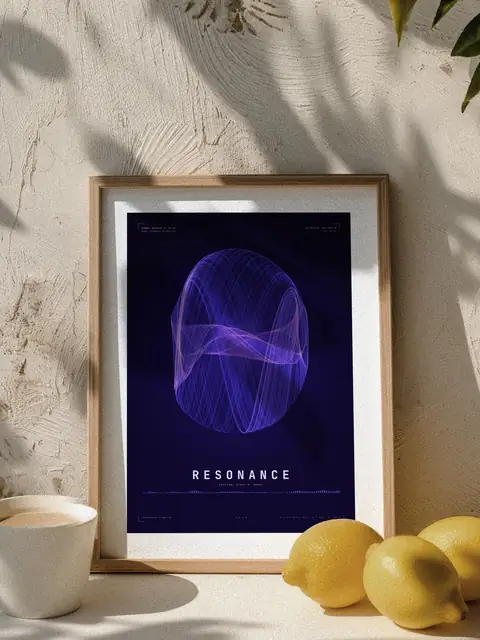
The light in the picture is density. Where the path passes more often, the line glows brighter. Nothing is painted by hand: the shape, the shading and the glow all come from the equations. Every product page lists the exact equations, parameters and measurements behind that piece.
FAQQuestions
What is a strange attractor in simple terms?
It is the shape a chaotic system settles into. The motion never repeats and is sensitive to its starting point, but it always stays on the same bounded, fractal shape.
What is the difference between an attractor and a strange attractor?
An ordinary attractor is a point or a closed loop, so the motion becomes still or periodic. On a strange attractor the motion never repeats, nearby paths drift apart, and the shape has a fractal dimension.
Is the Lorenz attractor the butterfly effect?
The butterfly effect is the property the Lorenz attractor made famous: tiny changes at the start grow into completely different outcomes. The two-winged shape of the attractor is often drawn as a butterfly too.
Which strange attractors can I get as a poster?
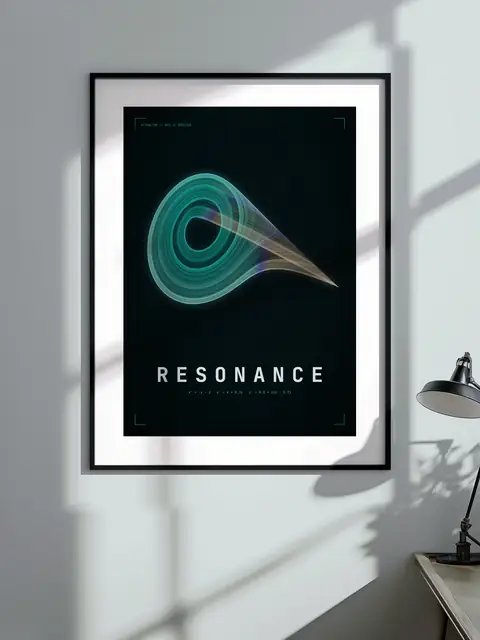
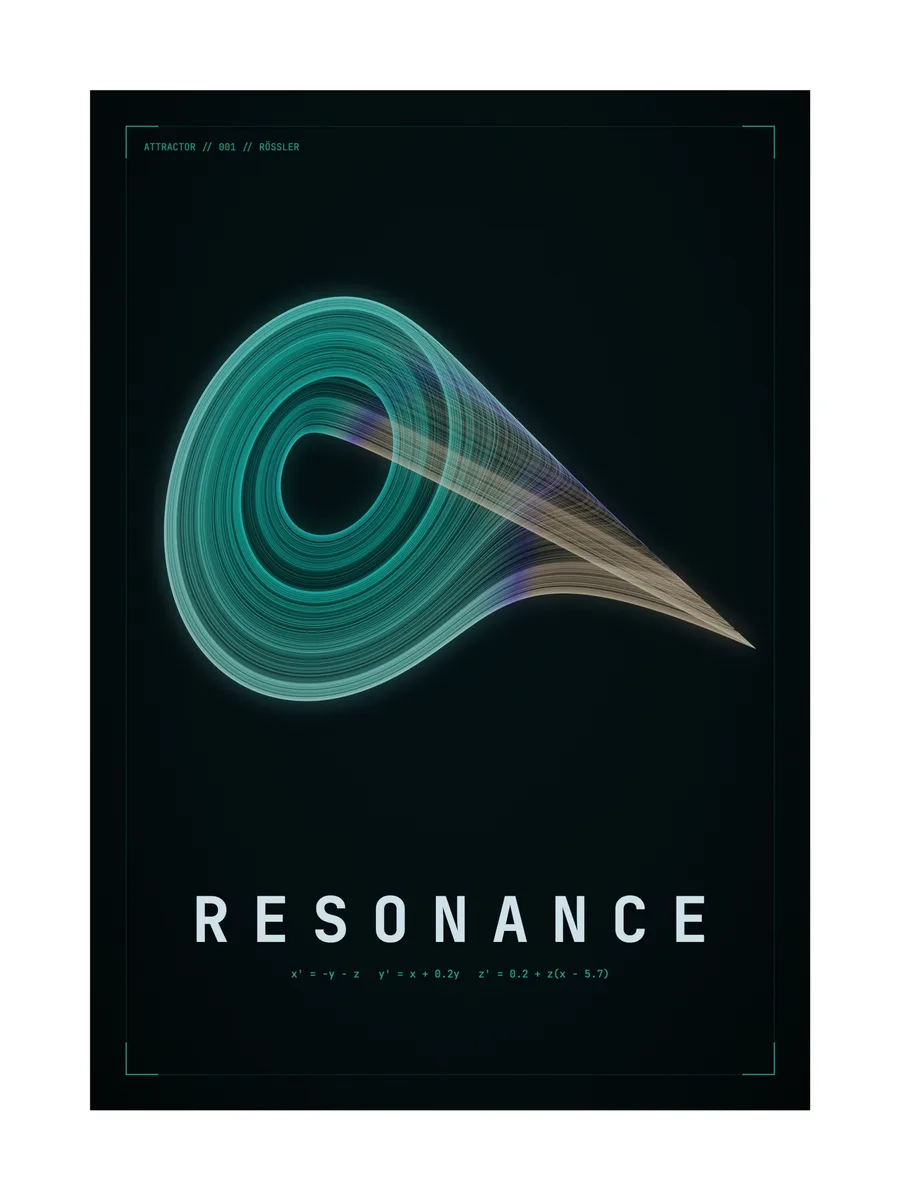
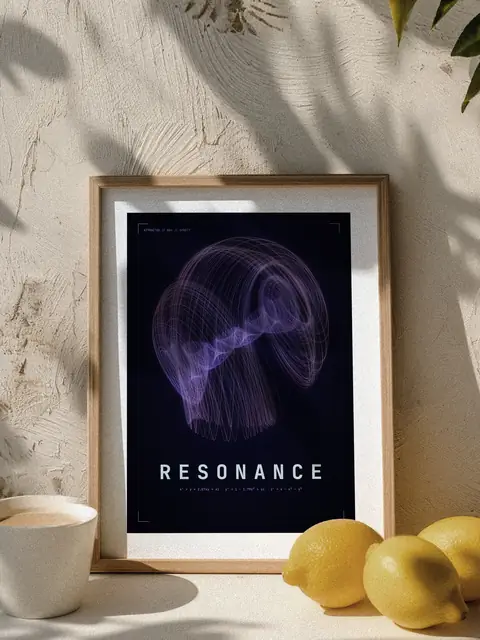
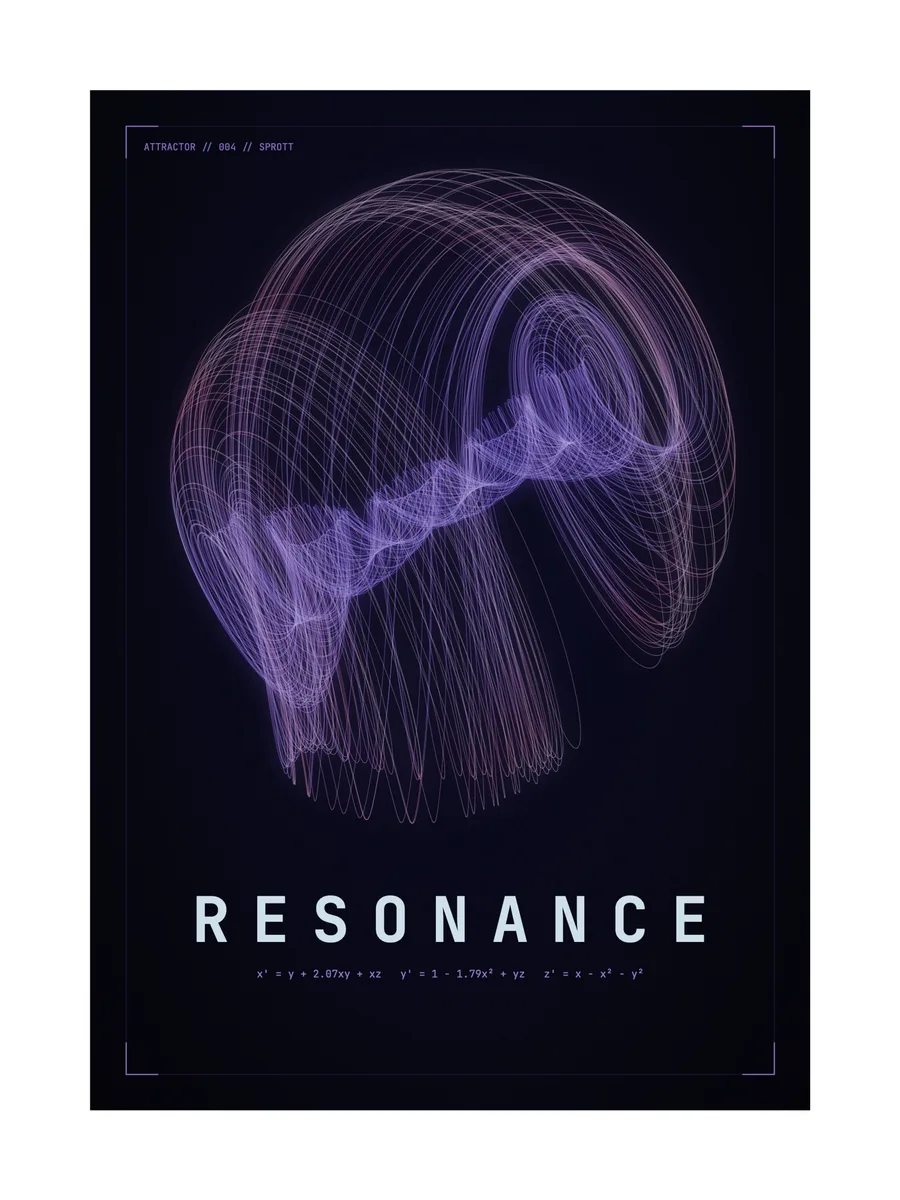
Our attractor series includes Lorenz, Thomas, Aizawa, Halvorsen, Rössler, Chen, Dadras, Sprott, Rabinovich, Four Wings, Clifford and De Jong, each printed on fine art matte paper.