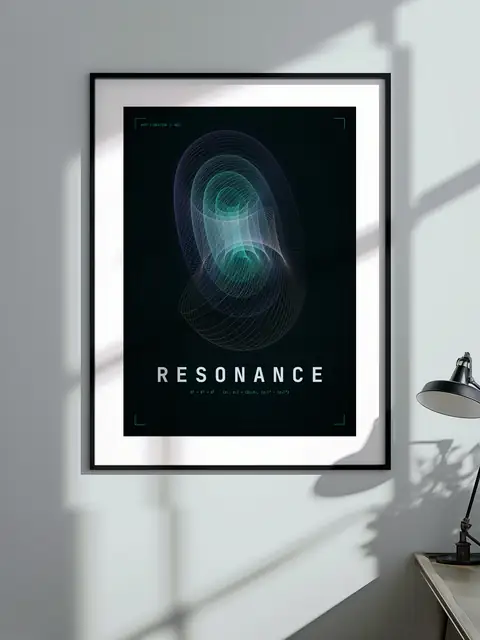
Guide // 4D geometry
The Hopf fibration explained
The Hopf fibration fills a four-dimensional sphere entirely with circles, every one of them linked with every other like the links of a chain. Here is what that means, and how it is brought down into our three dimensions to be drawn.
01A sphere in four dimensions
An ordinary circle is all the points at distance 1 from a centre in the flat plane. An ordinary sphere is the same idea in three dimensions. The three-sphere, written S³, is the same idea once more, in four dimensions: all the points (x, y, z, w) with x² + y² + z² + w² = 1.
We can't see four dimensions directly, but we can compute in them. A handy way is to pair the four coordinates into two complex numbers, z₁ = x + iy and z₂ = z + iw, so a point of S³ is a pair with |z₁|² + |z₂|² = 1.
|z₁|² + |z₂|² = 102Hopf's map
In 1931 the mathematician Heinz Hopf found a map that sends every point of S³ to a point on an ordinary sphere S². Many points of S³ land on the same spot of S², and they always form a circle. So S³ is filled completely with circles, one circle for every point of the ordinary sphere, and no two circles share a point.
A space filled with circles in this tidy way is called a fibration, and each circle is a fibre. Written as symbols, the circle S¹ sits inside the three-sphere S³, which lies over the sphere S².
S¹ → S³ → S²(z₁, z₂) ↦ (2z₁z̄₂, |z₁|² − |z₂|²)
03Every circle linked with every other
The surprising part: any two of these circles are linked. They never touch, yet you couldn't pull them apart without cutting one, just like two links of a chain. Hopf proved that this linking can't be undone by any smooth deformation, which made the fibration a landmark of topology.
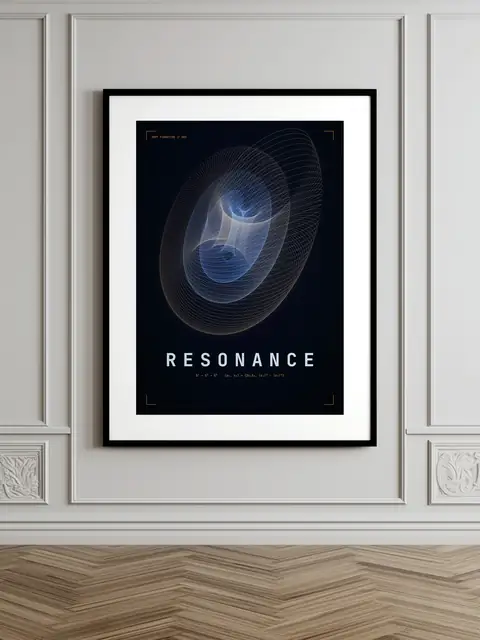
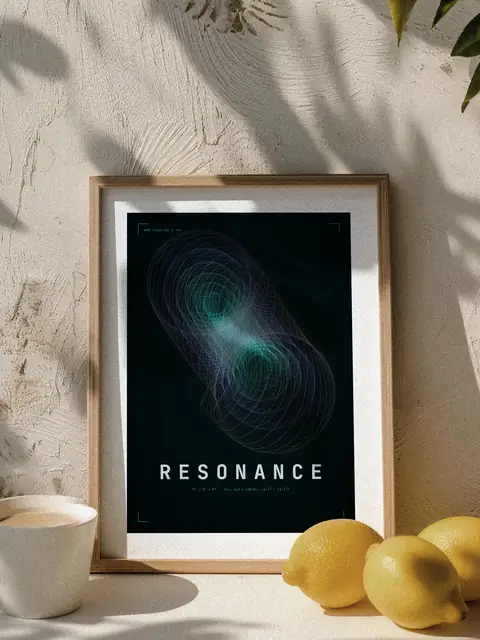
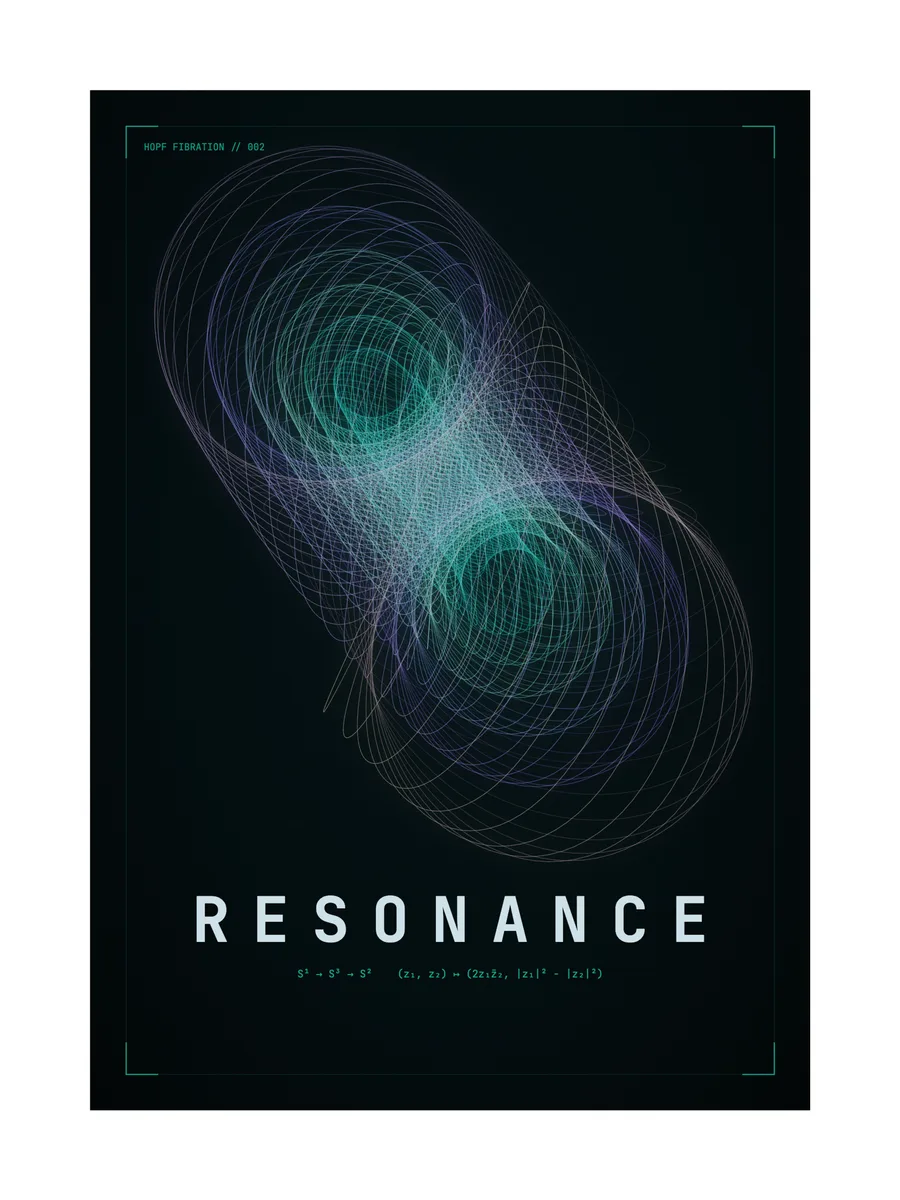
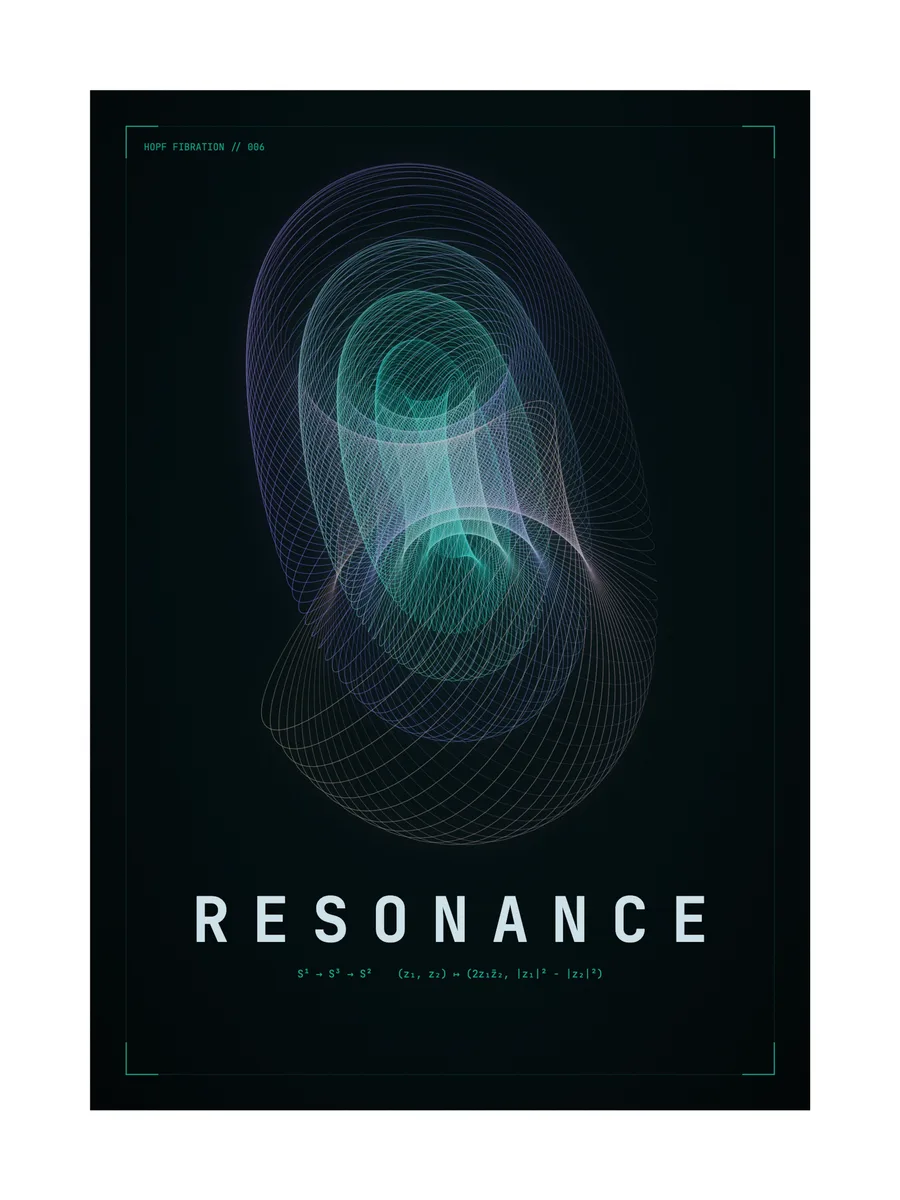
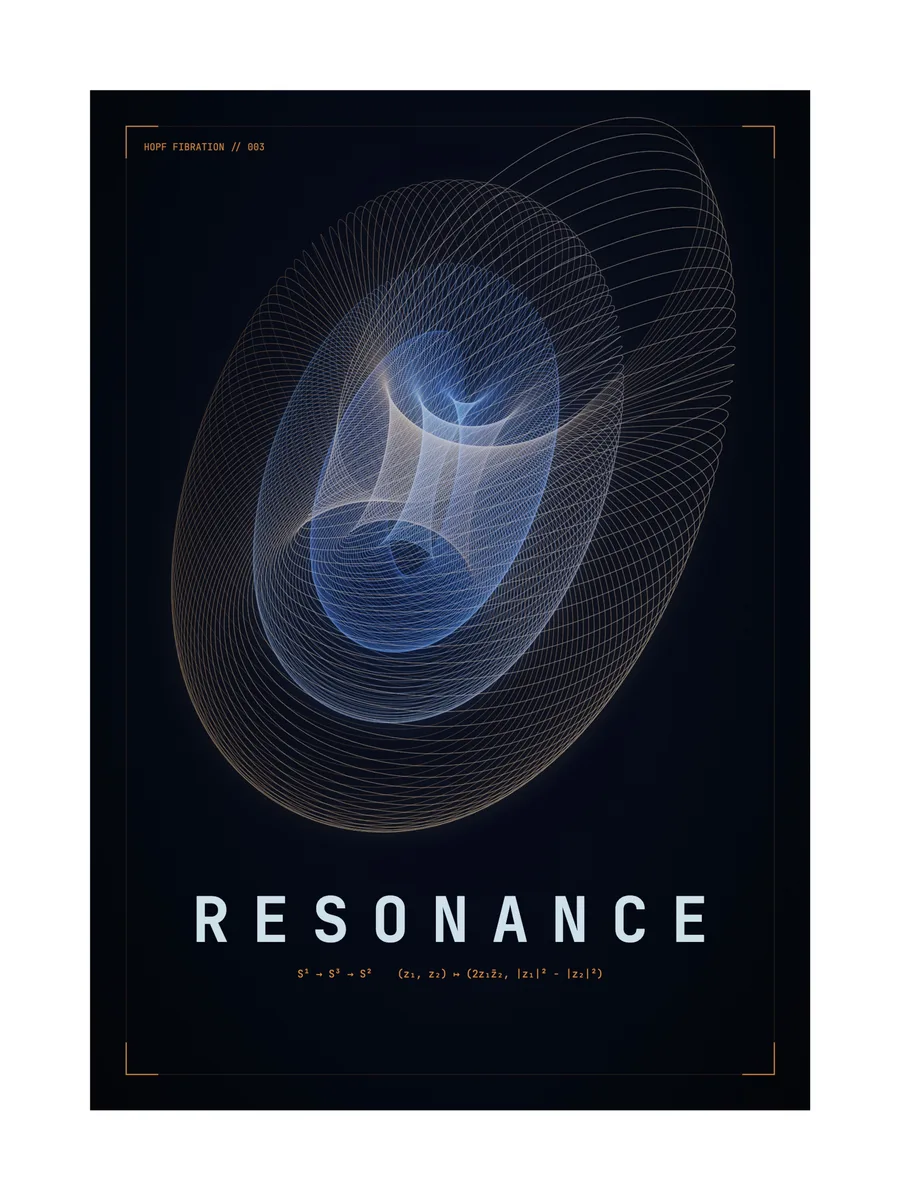
Take all the points on one circle of latitude of the ordinary sphere. Their fibres sweep out a torus, a doughnut shape, wound with circles that twist around it. Different latitudes give nested tori, one inside the next.
04Down into our space
To draw S³ we use stereographic projection, the same trick that maps the globe onto flat paper. Pick one point of S³ as the pole, then send every other point along a straight line from the pole into ordinary three-dimensional space.
This projection keeps circles as circles. The only exception is the fibre through the pole itself, which becomes a straight line running off to infinity. Every other fibre becomes an ordinary round circle, still linked with all the rest.
p ↦ (x, y, z) / (1 − w)05Where it turns up in physics
The Hopf fibration appears well beyond pure geometry. The state of a qubit, the basic unit of quantum information, is a point of S³ up to a phase, and the Bloch sphere that physicists draw is exactly the S² at the bottom of the Hopf map. It also shows up in the mathematics of the magnetic monopole and of spinning rigid bodies.
The films Dimensions by Jos Leys, Étienne Ghys and Aurélien Alvarez brought pictures of it to a wide audience.
06How our Hopf posters are made
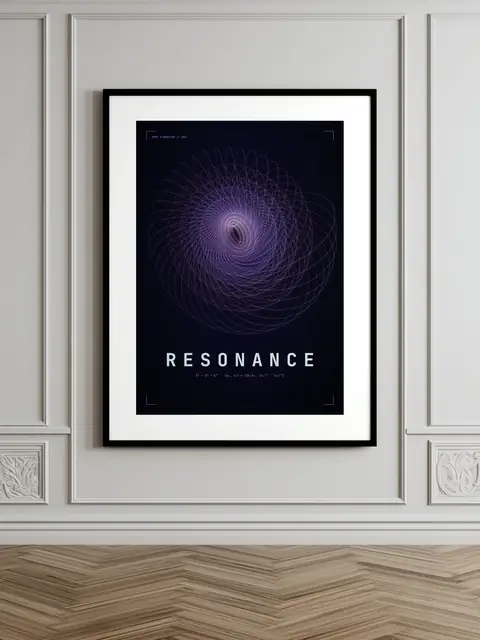
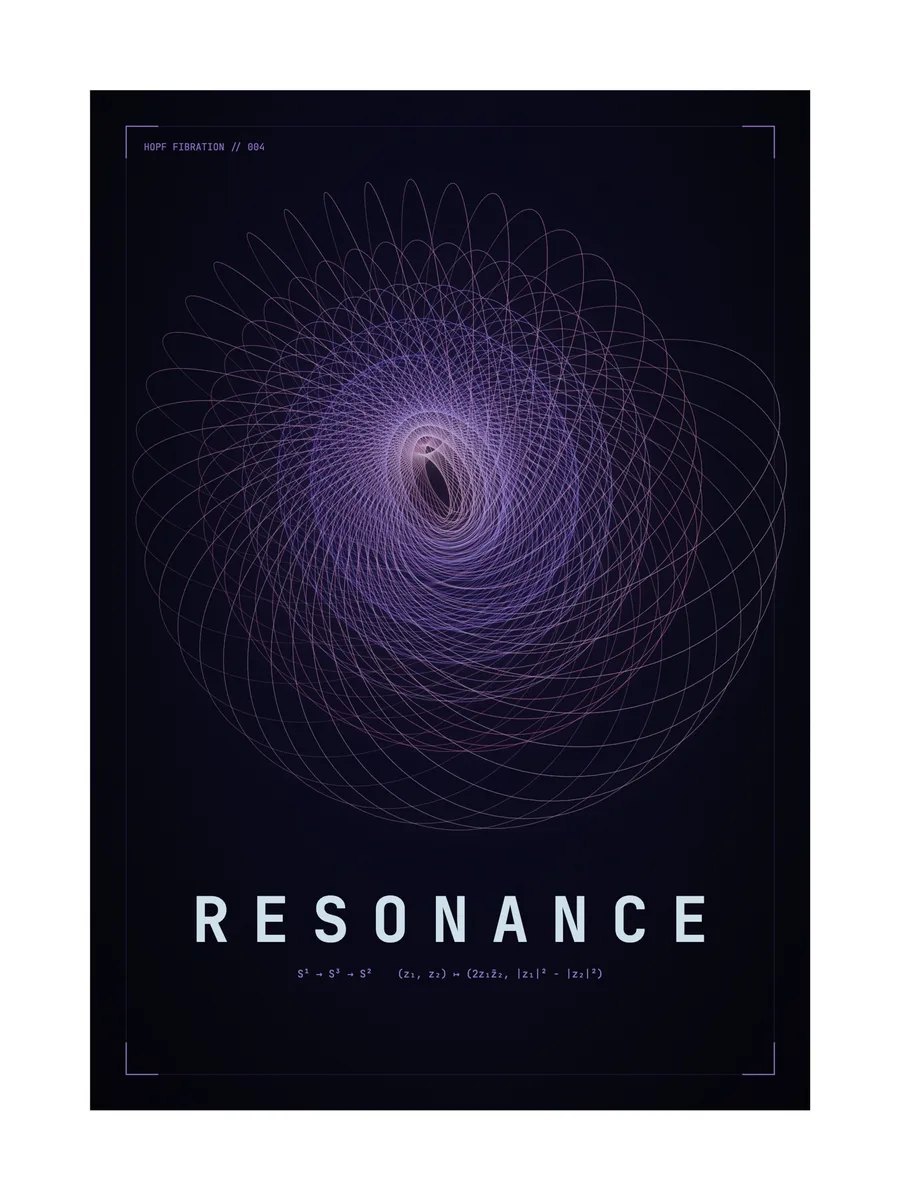
For each piece the program picks between 100 and 320 points on the ordinary sphere, either along several circles of latitude, which gives nested tori, or along a spiral from pole to pole, which gives a vortex. For every point it computes the matching circle in S³ at 260 points around it.
Each circle is projected stereographically, turned to the chosen viewing angle and drawn as a fine line of light, brighter towards the front. Nothing is approximated by hand: every ring on the poster is one exact fibre of the Hopf map.
FAQQuestions
What is the Hopf fibration in simple terms?
It is a way of filling the four-dimensional sphere S³ completely with circles, one for each point of an ordinary sphere, so that every pair of circles is linked like two links of a chain.
Why are the circles linked?
Because of how the Hopf map twists S³ around the sphere below it. Hopf proved in 1931 that the linking is a topological fact: no smooth deformation of the map can undo it.
How can you draw something from four dimensions?
With stereographic projection, which maps the four-dimensional sphere into ordinary 3D space and keeps circles as circles. The 3D picture is then viewed from an angle, like any object.
What are the tori in Hopf fibration pictures?
The circles that lie over one circle of latitude on the ordinary sphere sweep out a torus. Several latitudes give nested tori, each wound with linked circles.