The story
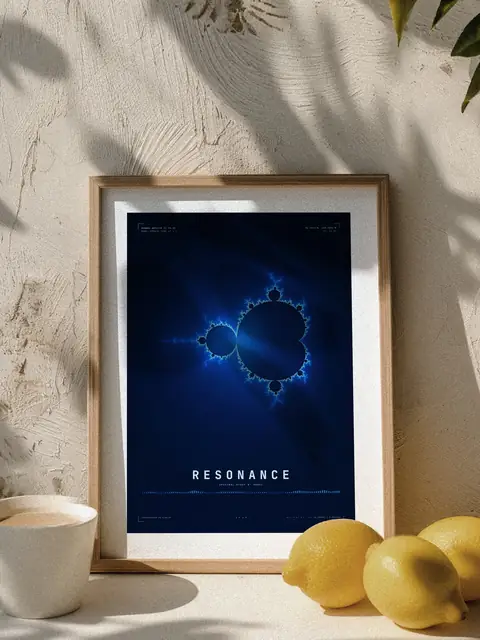
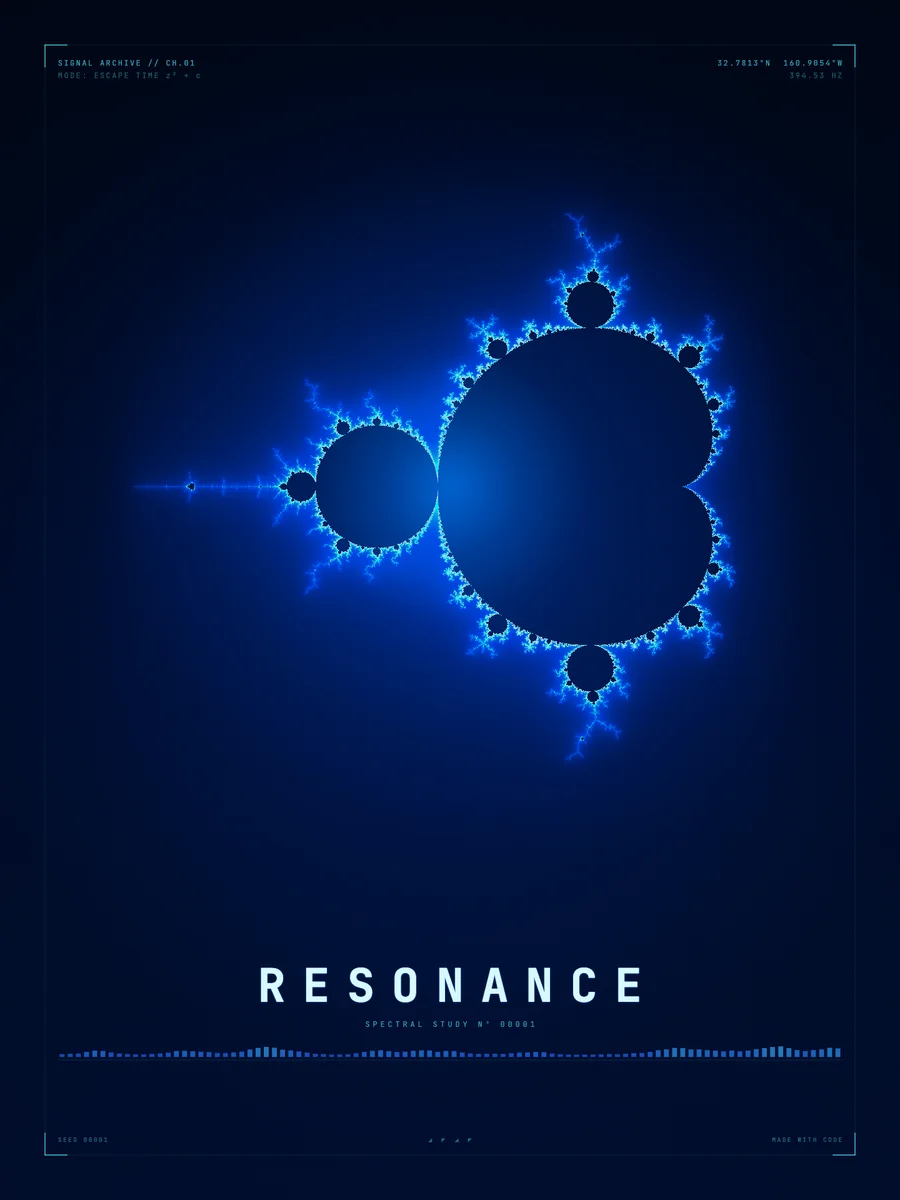
Near −1.757 on the real axis sits a shrunken copy of the whole set. There are infinitely many such copies, all joined to the main set. Adrien Douady and John Hubbard proved in 1982 that the set is connected in one piece.
200 gsm enhanced matte
Printed on thick uncoated art paper at 300 DPI. Rich colour, razor-sharp lines, no glare.
Black or natural wood
Wooden frame, 22 mm deep, with plexiglass that is lighter and safer than glass. Arrives ready to hang.
Free shipping worldwide
Each print is made for you when you order and packed to arrive flawless, wherever you are.
The story
Near −1.757 on the real axis sits a shrunken copy of the whole set. There are infinitely many such copies, all joined to the main set. Adrien Douady and John Hubbard proved in 1982 that the set is connected in one piece.
MATHEMATICS
Every piece is computed, not drawn. These are the real equations and numbers from the program that made this exact piece.
Read the guide: The Mandelbrot set explained →zₙ₊₁ = zₙ² + cz₀ = 0|zₙ| > 2 ⇒ c ∉ M
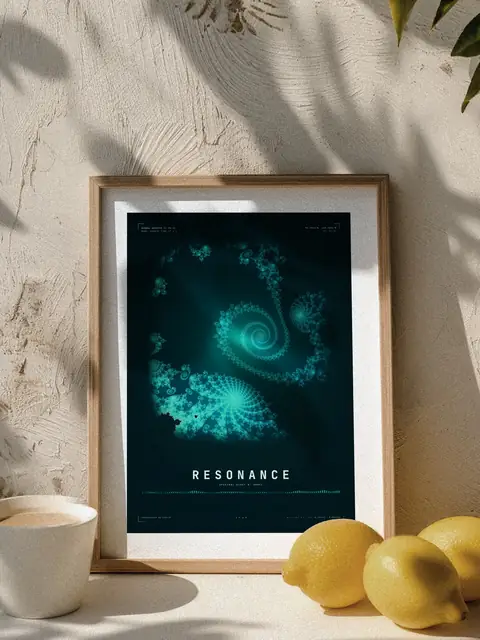
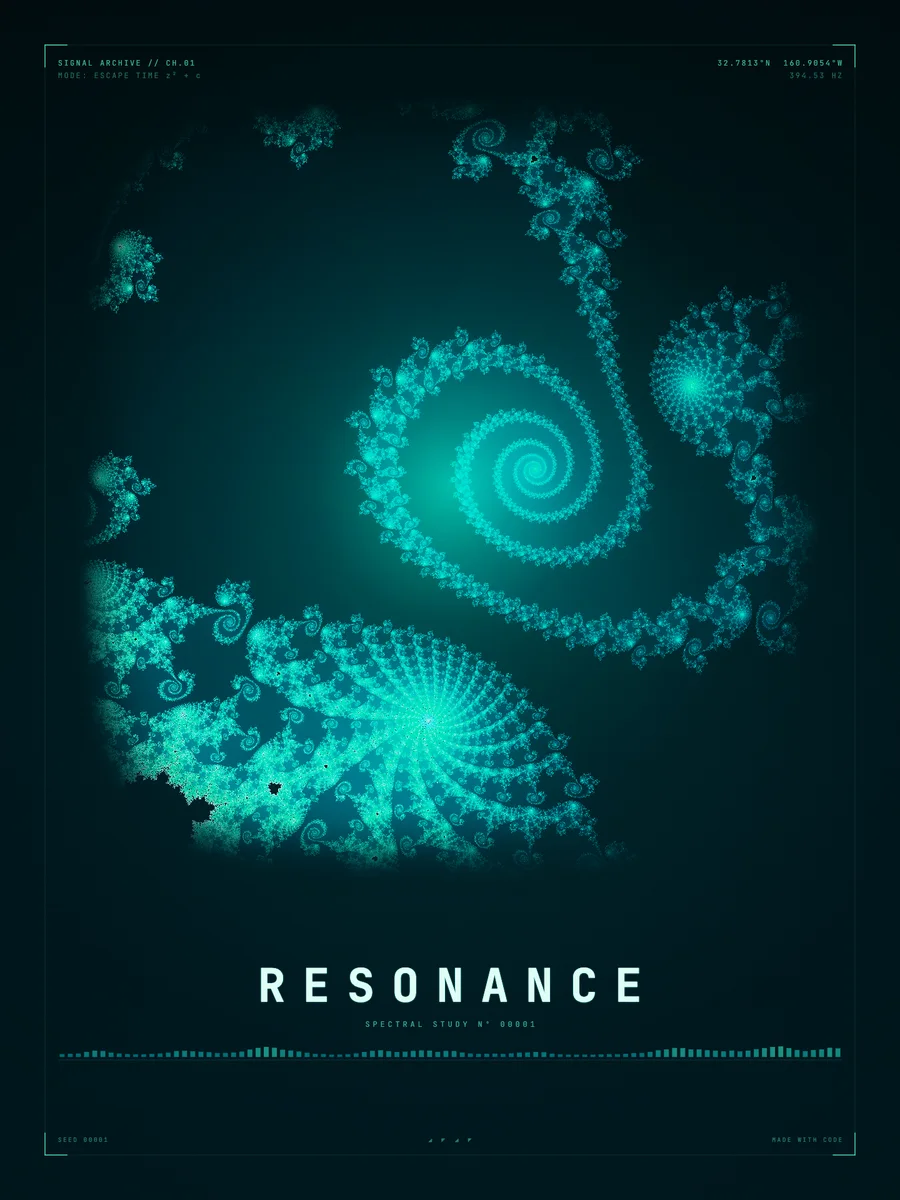
This window is magnified 46 times. 10.6% of points stay trapped in the set forever; the rest escape after 18 steps on average. Each point's colour is exactly that step count.
HISTORY
Gaston Julia and Pierre Fatou study the iteration of complex functions, with no computers, only pencil and paper.
Robert Brooks and Peter Matelski publish the first picture of the set, printed in characters on a line printer.
Benoit Mandelbrot at IBM explores the set by computer and reveals its infinite complexity. He had coined the word "fractal" in 1975.
Adrien Douady and John Hubbard prove the set is connected and name it after Mandelbrot.
Ferns, romanesco cauliflower and a sea coast share the property of the set's edge: the part looks like the whole. In 1967 Mandelbrot asked how long the coast of Britain is. The answer depends on how finely you measure.
Follow along
Explore other series