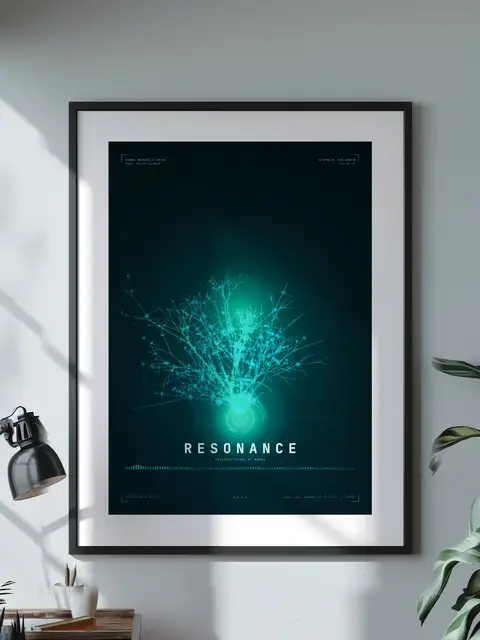
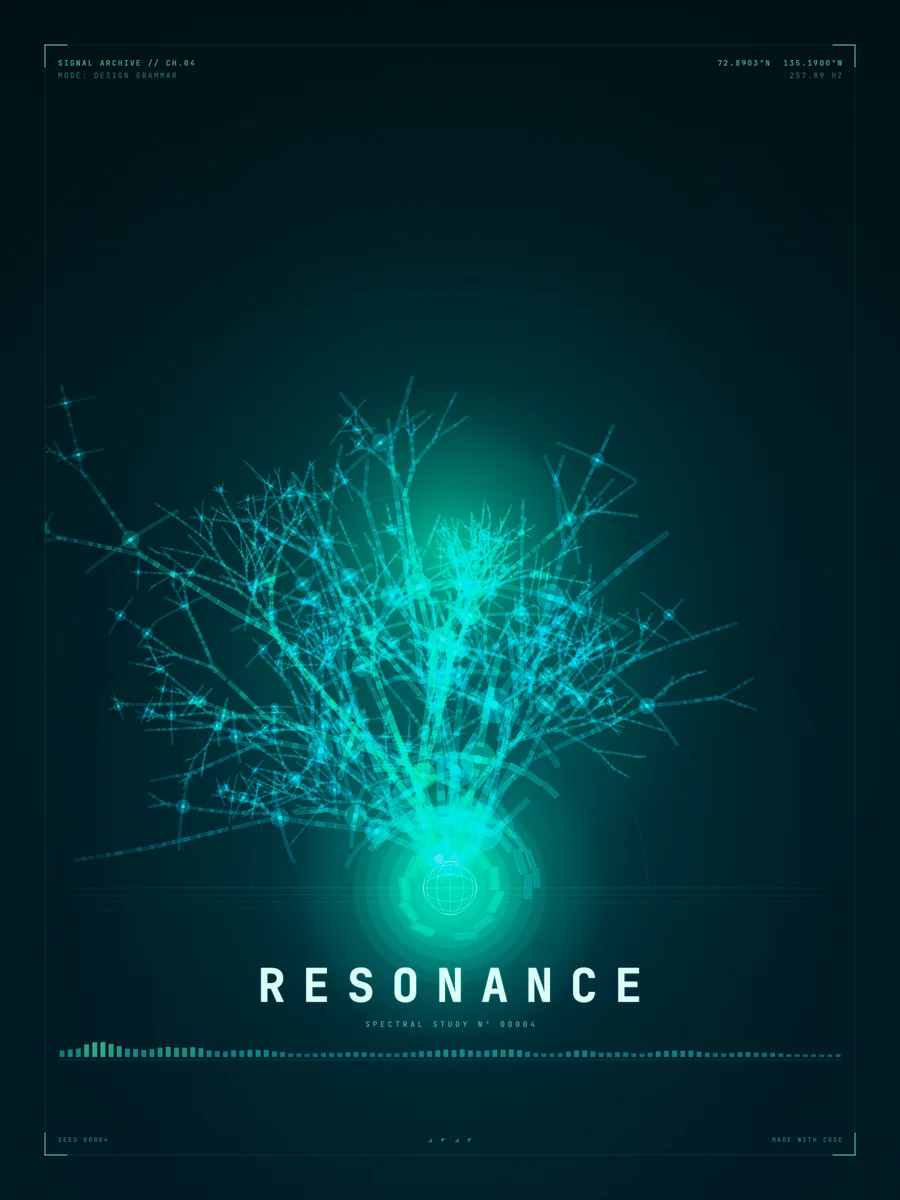
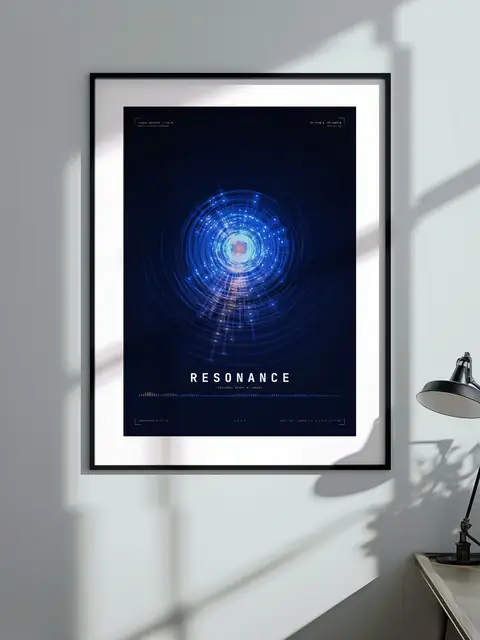
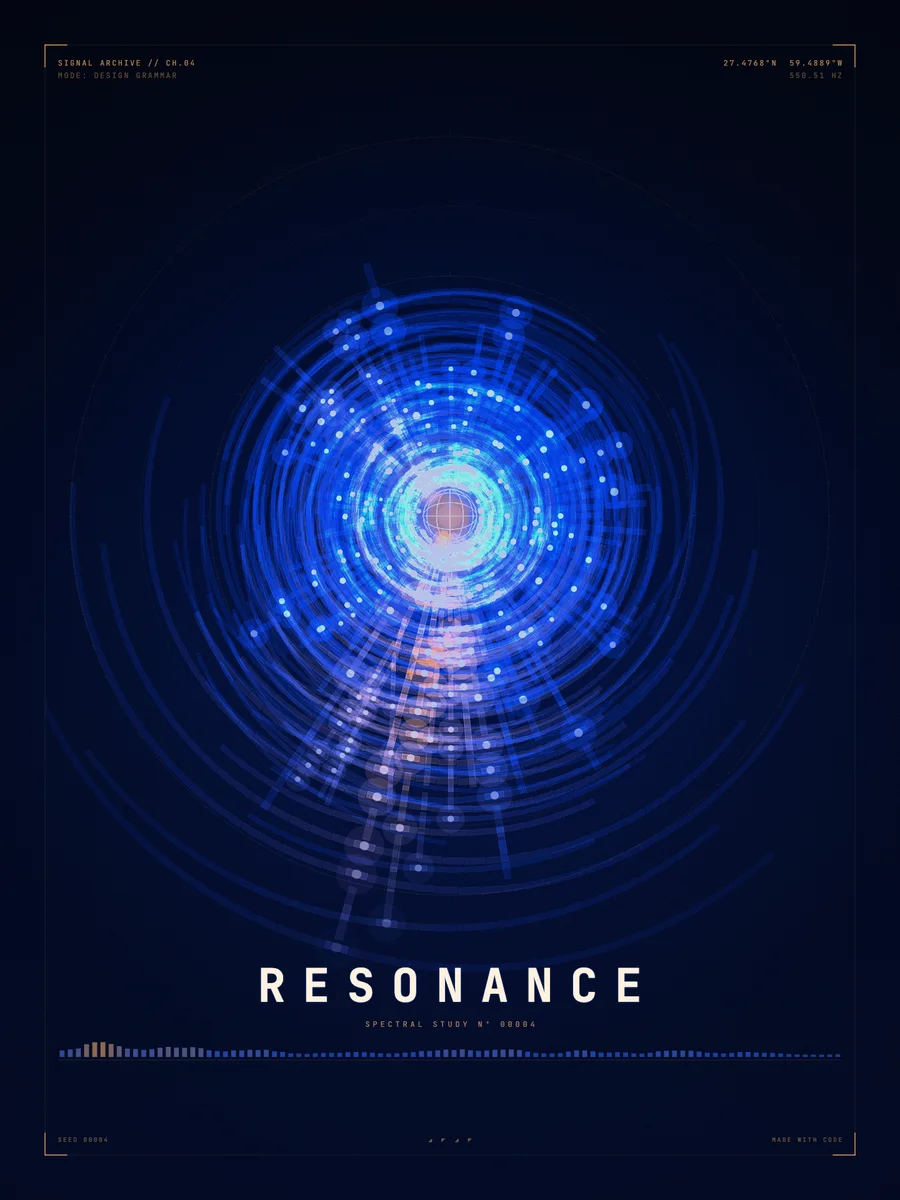
The story
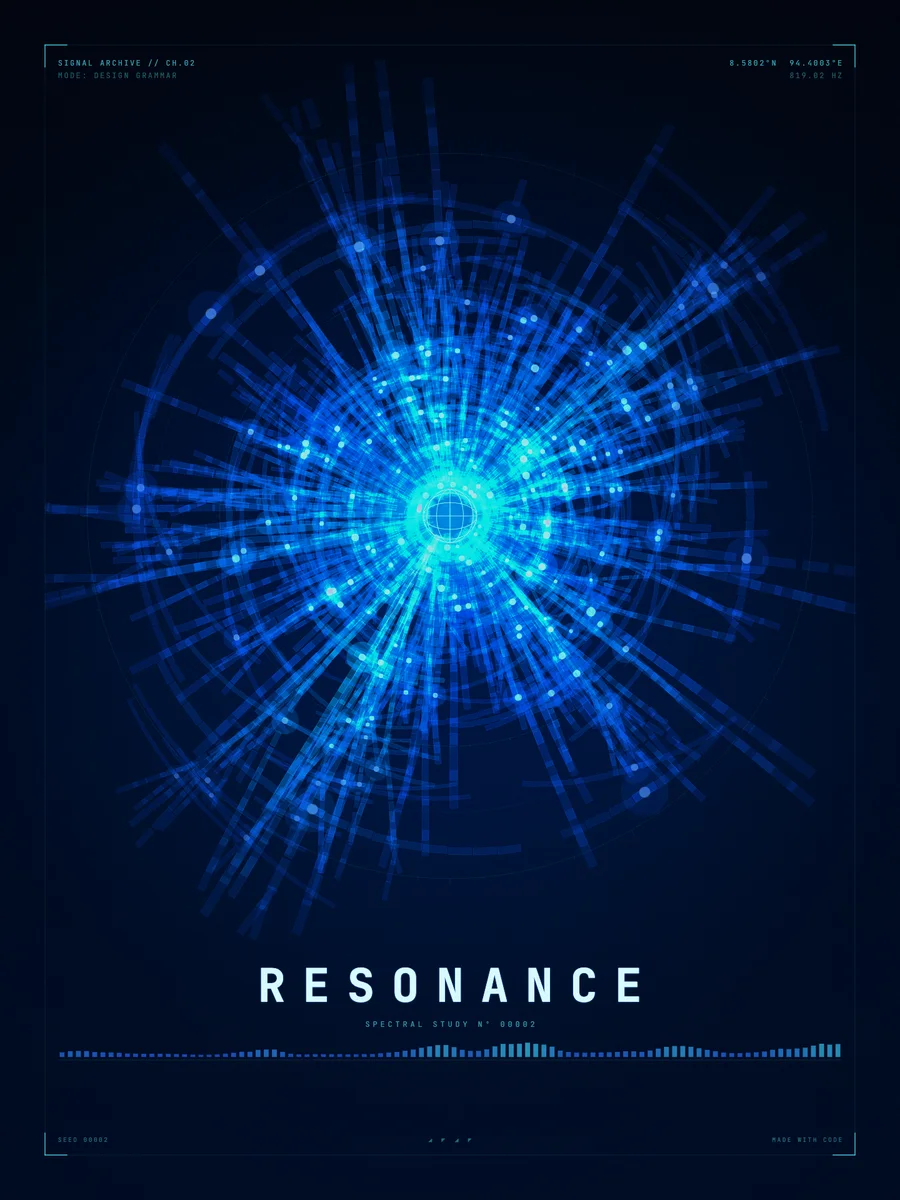
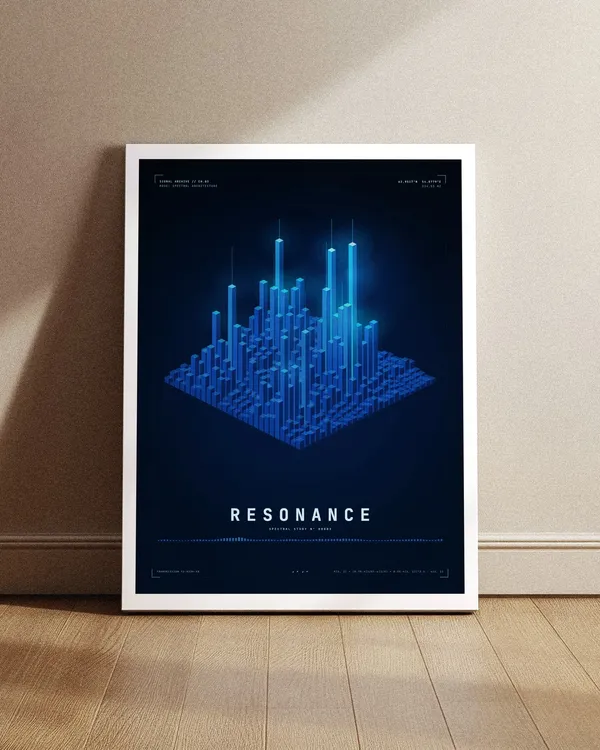
Two cores, one hundred and ninety rays. Each core builds its rays by the same rules, and where the rays meet, blocks pile up and glow. Binary stars are not rare: roughly half of all Sun-like stars have a companion.
200 gsm enhanced matte
Printed on thick uncoated art paper at 300 DPI. Rich colour, razor-sharp lines, no glare.
Black or natural wood
Wooden frame, 22 mm deep, with plexiglass that is lighter and safer than glass. Arrives ready to hang.
Free shipping worldwide
Each print is made for you when you order and packed to arrive flawless, wherever you are.
The story
Two cores, one hundred and ninety rays. Each core builds its rays by the same rules, and where the rays meet, blocks pile up and glow. Binary stars are not rare: roughly half of all Sun-like stars have a companion.
MATHEMATICS
Every piece is computed, not drawn. These are the real equations and numbers from the program that made this exact piece.
Read the guide: Perlin noise explained →spoke → box · spoke(x + 2, rz ± 1.4°, s × 1.05) p = 84%spoke → box · spoke(rz + θ, s × 0.8) · spoke(rz − θ, s × 0.8) p = 8%spoke → node · arc · arc · spoke p = 6%arc → box · arc(rz = step / r)s(t) = Σₖ aₖ·(½ + ½·sin(2π·fₖ·t + φₖ)) · Σⱼ bⱼ·e^(−((t − cⱼ)/wⱼ)²)
The form is driven by a sound signal made of the frequencies 5.82 · 16.832 · 7.776 · 17.743. Where the signal is louder, the structure grows further.
Nature is neither perfectly smooth nor completely random: clouds, mountains and waves are somewhere in between. In 1983 Ken Perlin invented a noise that looks like nature: a smooth function that gives random but gentle changes. The program adds four layers (octaves) of this noise, each half as strong and twice as fine as the last. That is what gives the lines life, so they don't look like they were drawn with a ruler.
HISTORY
Noam Chomsky describes formal grammars: a finite set of rules that can generate infinitely many sentences.
Biologist Aristid Lindenmayer applies the same idea to plants. His L-systems describe how branches grow using rewriting rules.
Context Free Art brings grammars into art: a picture is a program of a few rules that call themselves.
Mikael Hvidtfeldt Christensen releases Structure Synth, extending grammars into three dimensions. This series grows from there.
Ken Perlin works on the effects for the film Tron and is frustrated that computer images look too "machine-like".
Perlin invents his noise and publishes it in 1985 at SIGGRAPH, in the paper "An Image Synthesizer".
Perlin receives an Academy Award for Technical Achievement: his noise becomes the basis of smoke, fire and cloud textures in film.
Perlin publishes an improved version and "simplex" noise. Today games, films and programmer art all over the world use it.
Recursive rules for plant growth were first written down in 1968 by biologist Aristid Lindenmayer, watching algae: a cell divides, and each new branch repeats the old one.
Follow along
Explore other series