SERIES D // PHASE FLOW
Ток · Flux
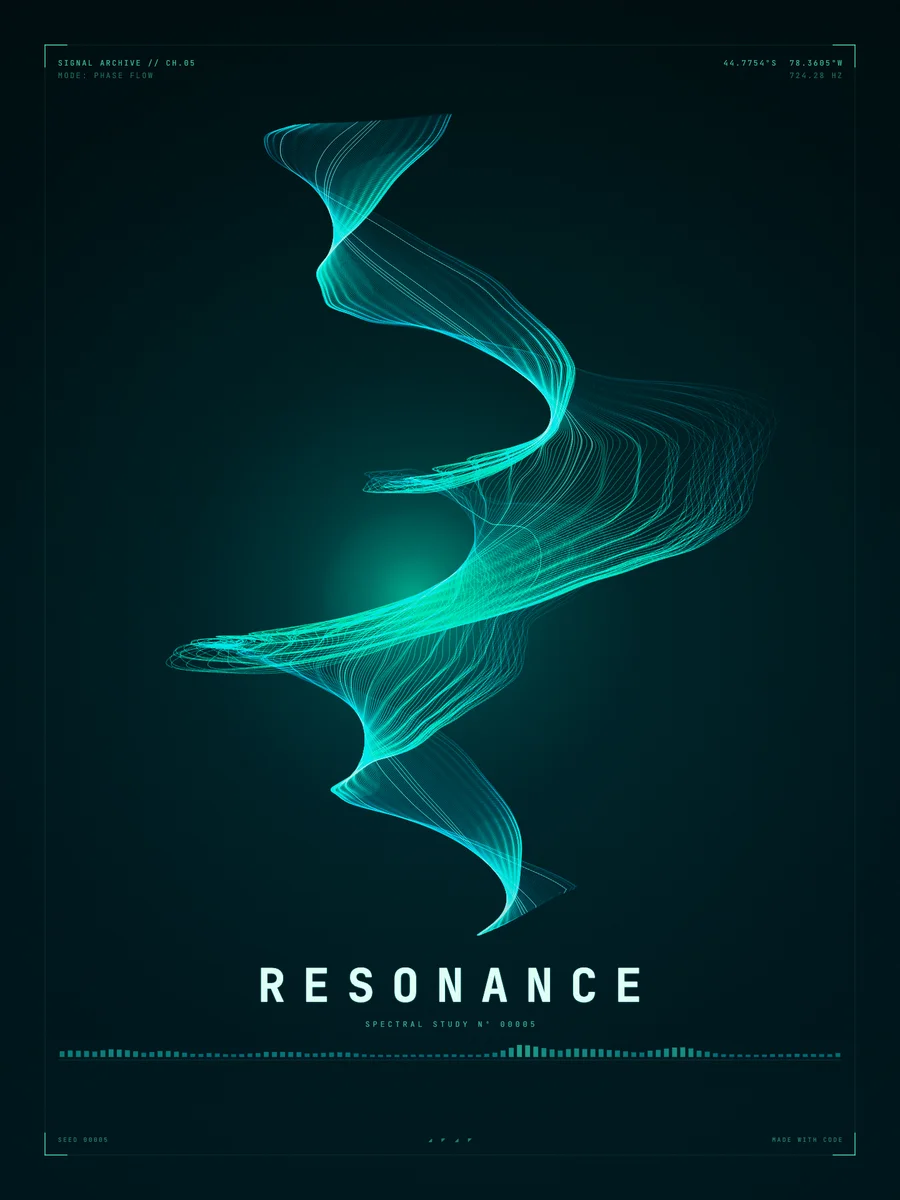
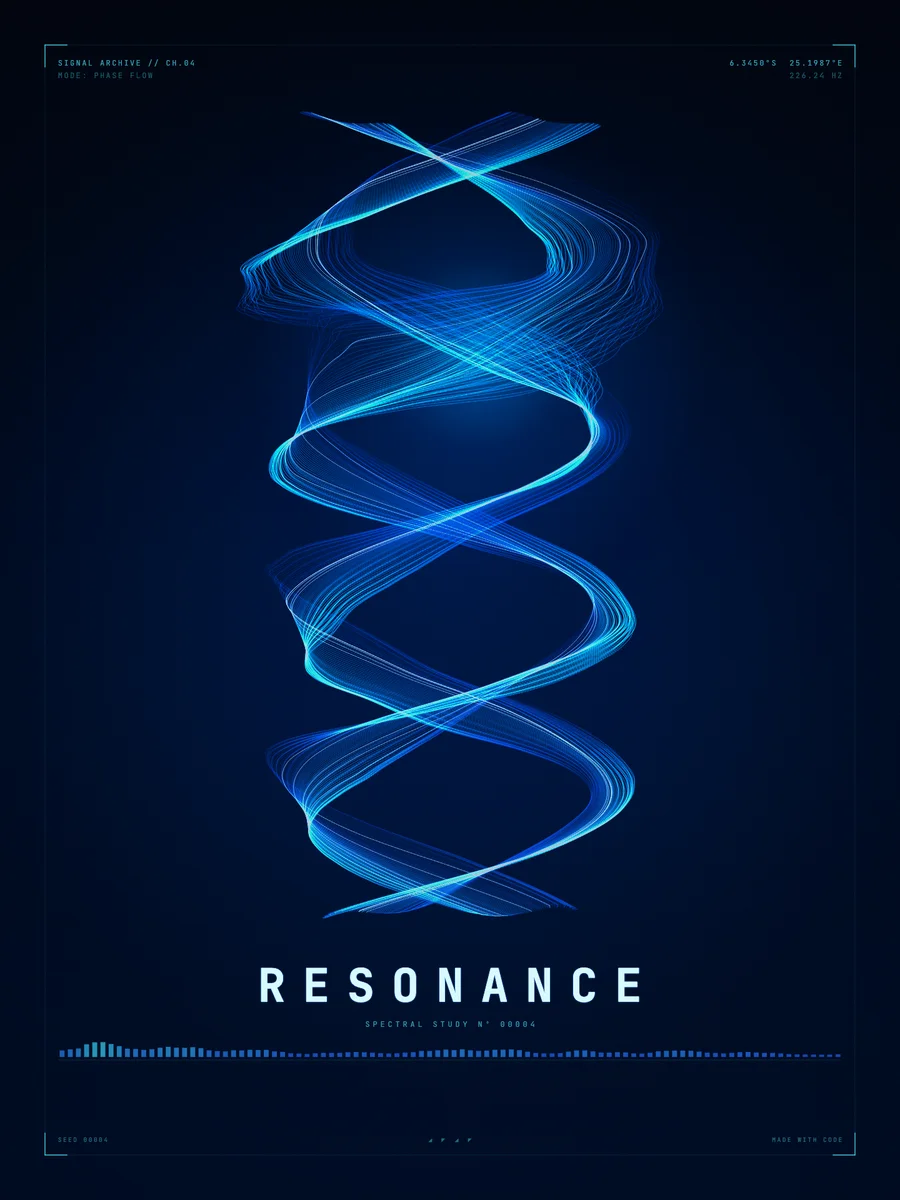
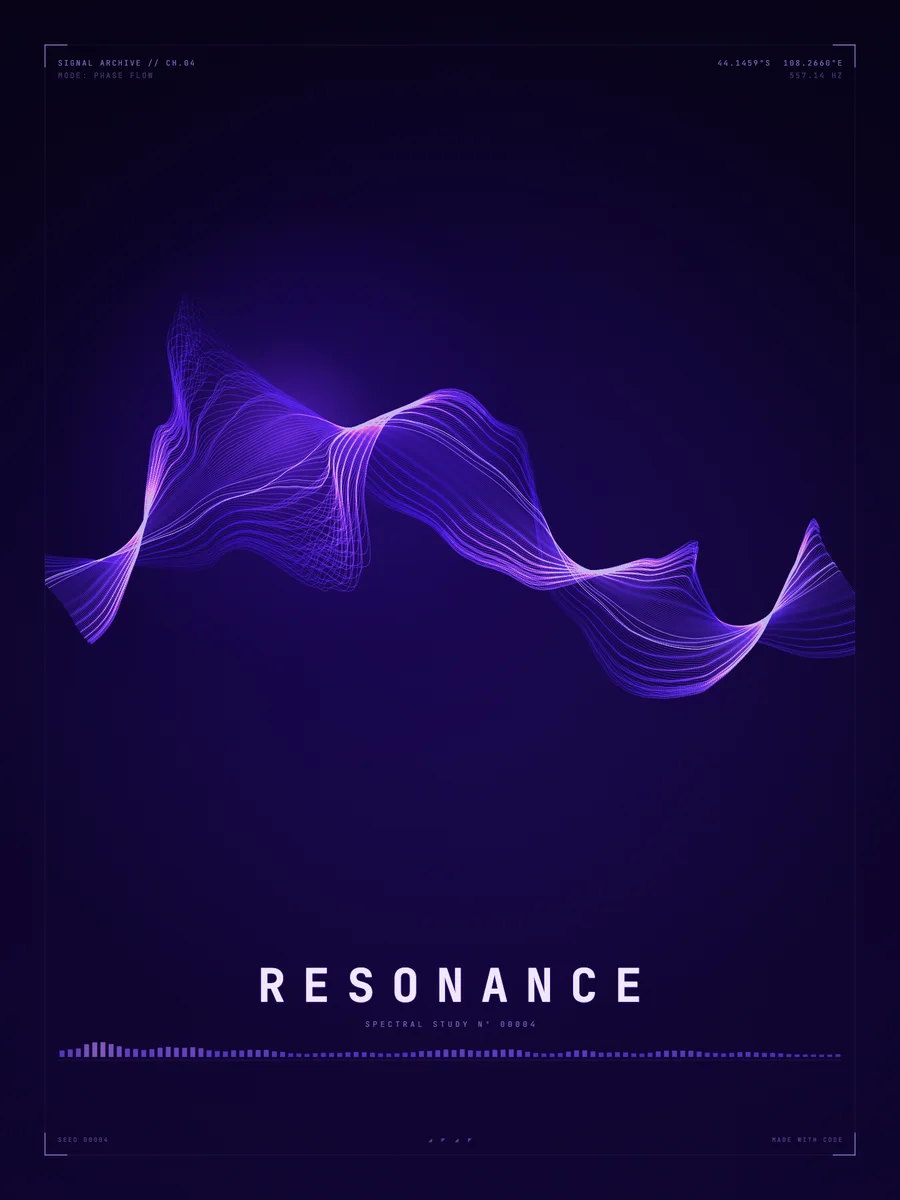
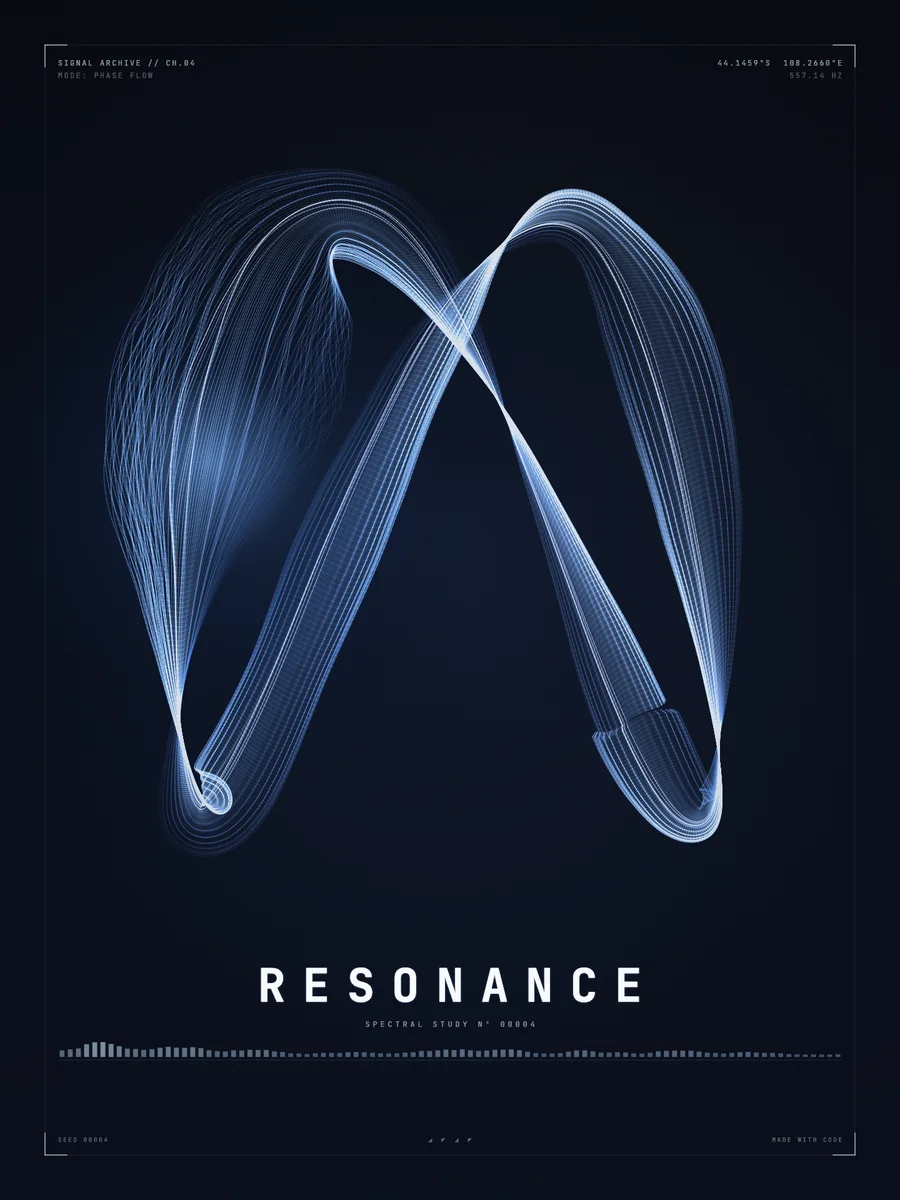
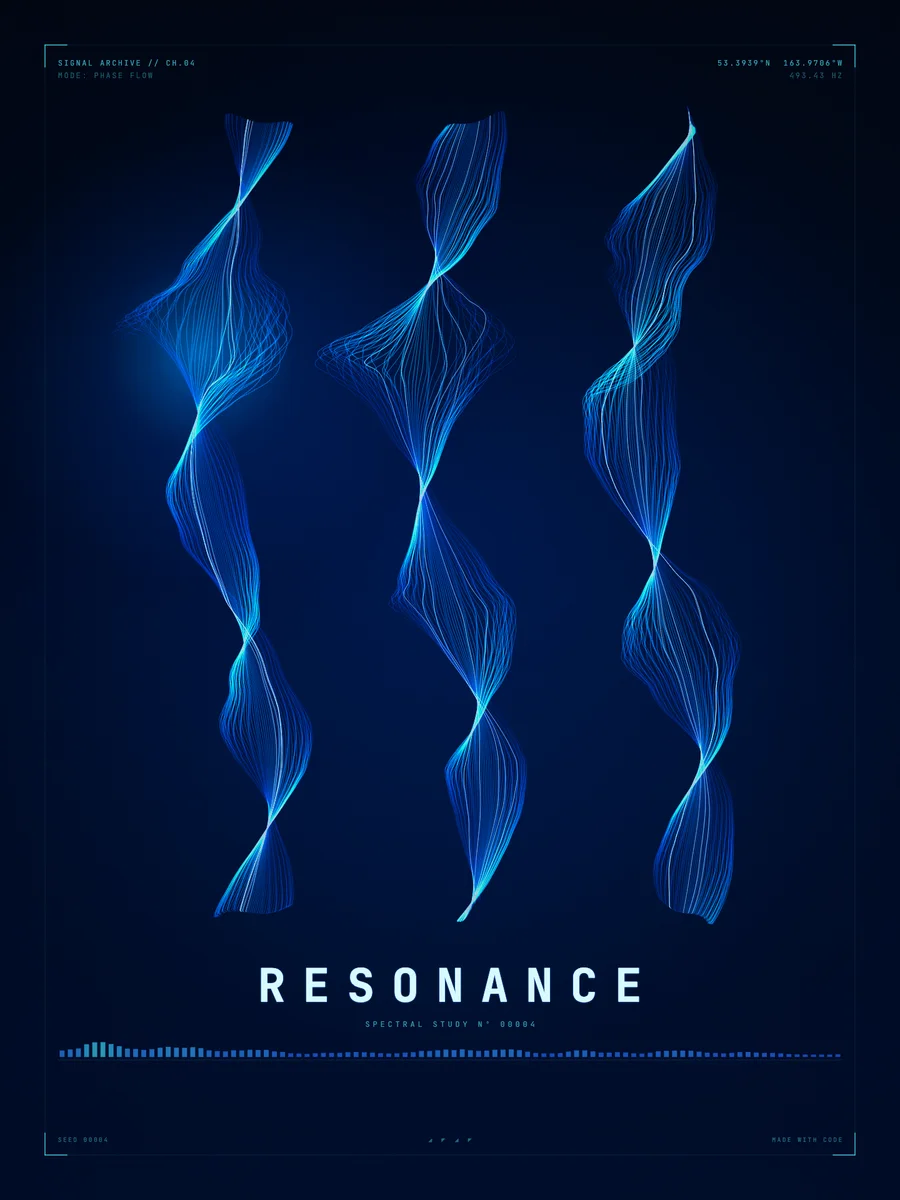
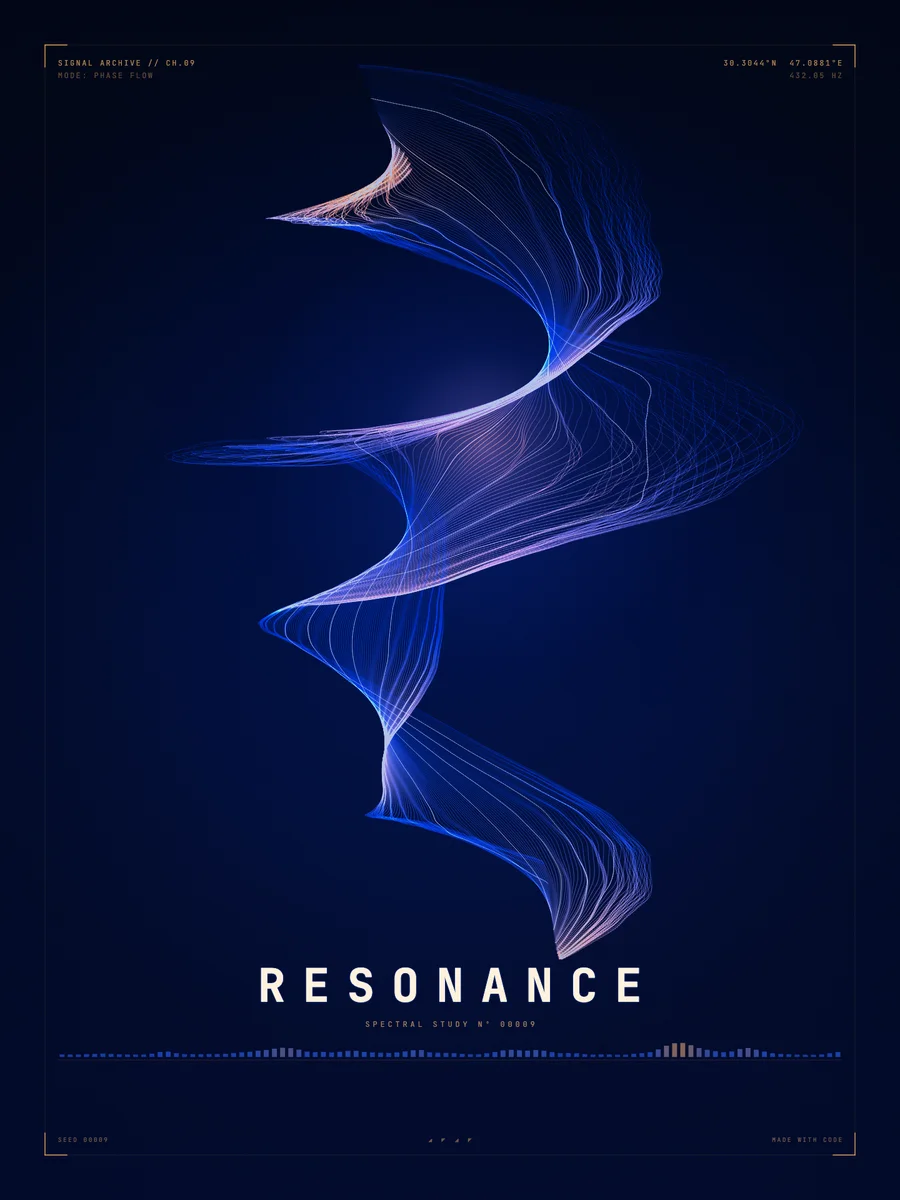
Hundreds of threads of light woven into a single ribbon. A signal twisting through space like silk in zero gravity.
MATHEMATICS
The maths behind the picture
- 01
A surface in motion
Each ribbon is a parametric surface: hundreds of lines placed around a cross-section that rotates as it travels along a curve. What looks like fabric is pure geometry.
P(t, φ) = C(t) + h(t)·sin φ·(cos θ(t)·N + sin θ(t)·T) - 02
The twist
The angle θ(t) grows linearly, plus a little noise, so the ribbon turns evenly but never mechanically. Lines in front are brighter and lines behind are darker, so the eye reads depth.
θ(t) = 2π·k·t + θ₀ + noise(t) - 03
Width is loudness
Where the signal is loud, the ribbon widens. The signal's highest point is the focal point of the picture.
h(t) = w₀ + w₁·s(t)^1.1 - 04
Perlin noise
Nature is neither perfectly smooth nor completely random: clouds, mountains and waves are somewhere in between. In 1983 Ken Perlin invented a noise that looks like nature: a smooth function that gives random but gentle changes. The program adds four layers (octaves) of this noise, each half as strong and twice as fine as the last. That is what gives the lines life, so they don't look like they were drawn with a ruler.
noise(x) = Σₖ 0.5ᵏ · perlin(2ᵏ·x), k = 0…3
HISTORY
Where this idea comes from
Flux
- 1847
Jean Frenet (1847) and Joseph Serret (1851) independently describe how orientation changes along a curve in space: tangent, normal and binormal.
- 1960s
Early computer artists such as Frieder Nake and Georg Nees use plotters to draw lines defined by equations.
- today
Parametric surfaces are the basis of 3D graphics, from cars to animation. Here one such surface becomes a ribbon of light.
Perlin noise
- 1982
Ken Perlin works on the effects for the film Tron and is frustrated that computer images look too "machine-like".
- 1983
Perlin invents his noise and publishes it in 1985 at SIGGRAPH, in the paper "An Image Synthesizer".
- 1997
Perlin receives an Academy Award for Technical Achievement: his noise becomes the basis of smoke, fire and cloud textures in film.
- 2001
Perlin publishes an improved version and "simplex" noise. Today games, films and code art all over the world use it.